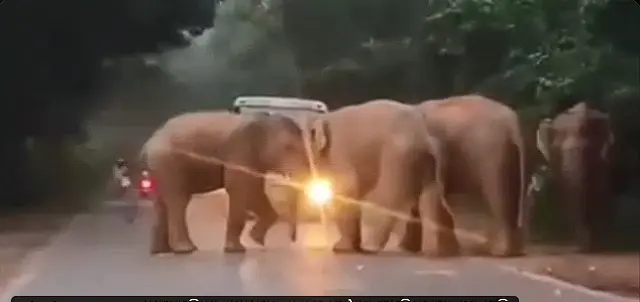
Bhubaneshwar: A long-term study of human-elephant conflict in Odisha has found that elephant deaths are heavily concentrated in areas where forests overlap with mines, settlements, farmland and transport infrastructure.
The assessment, titled Human-Elephant Conflict in the State of Odisha (2000–2025): Trends, Challenges and Insights, was conducted by the Wildlife Institute of India and Project Elephant. It examined official Forest department data from 45 divisions over 25 years.
Human Activity Claims 508 Elephants
The study recorded 1,671 elephant deaths in Odisha between 2000 and 2025. Human-related factors accounted for at least 508 deaths, or nearly 30 per cent of the total number of elephant death. The remaining cases were attributed to disease, physiological conditions, natural accidents and fights between elephants.
Electrocution was the leading anthropogenic (means caused, created, or influenced by human activity) cause, killing 274 elephants. Poaching accounted for 129 deaths, while train accidents claimed 45. Poisoning caused 20 deaths, and retaliatory killings linked to conflict resulted in 16 fatalities. Another 16 elephants died after falling into wells, tanks, canals, trenches, drains and other man-made structures. Vehicle collisions accounted for eight deaths, as reported by The New Indian Express.
These included 328 adult females, 283 adult males, 269 sub-adults, 222 juveniles and 246 calves. The age could not be established in 323 cases.
Mining Areas Face Greater Risk
The mortality model showed that elephant deaths were more common near mines, forests, protected areas, built-up zones, croplands and railway lines. Of these factors, proximity to mines had the strongest association with mortality.
Northern and central Odisha, particularly its mineral-rich belt, has witnessed extensive mining, road and railway construction and settlement expansion. These activities have fragmented forests and interfered with traditional elephant routes.
The report did not link deaths to any specific mine, railway track or village. Instead, it found that fatalities generally occurred in wider forest-mine-settlement landscapes where elephants encountered farms, villages, power lines and transport networks while moving beyond forest habitats.
Dhenkanal Tops Mortality Chart
Dhenkanal recorded the highest number of elephant deaths at 229, followed by Athagarh with 178, Keonjhar territorial division with 150, Similipal Tiger Reserve with 100 and Satkosia Wildlife Division with 80.
Dhenkanal also reported the highest anthropogenic mortality at 78, followed by Keonjhar with 66, Angul with 38 and Athagarh with 30.
Disease remained the biggest natural cause, accounting for 469 deaths. Physiological causes claimed 309 elephants, while natural accidents and territorial fights resulted in 95 and 53 deaths, respectively.
1,677 Human Deaths Recorded
The assessment documented 2,242 conflict incidents across 244 villages, causing 1,677 human deaths and 565 injuries. The worst annual toll came in 2023, when 175 people died in 243 incidents.
Dhenkanal recorded 355 human deaths, followed by Keonjhar with 155, Angul with 141, Rourkela with 140 and Khurda with 45.
The report identified Dhenkanal, Athagarh, Angul, Keonjhar, Bonai and Rourkela as priority landscapes. It recommended safer electrical systems, removal of illegal fences, monitoring of railway crossings, protection of elephant corridors and stronger village-level warning and response mechanisms.
AI Tools For Early Alerts
The study has suggested testing AI systems at elephant routes, settlement edges and risky railway crossings. Cameras and thermal sensors could detect elephants and quickly alert control rooms and field teams.
A similar system in West Bengal recorded 266 detections and sent alerts in about 42 seconds on average. The report said the technology should first be tested at selected sites for accuracy, false alarms, missed detections and response time.
It also recommended better post-mortem examinations, disease monitoring and forensic investigations into elephant deaths.
“Reducing elephant deaths and human casualties in Odisha requires coordinated action across key departments and local communities. Annual hotspot assessments, geospatial monitoring and targeted interventions in high-risk landscapes are essential to improve human safety while conserving elephant movement,” the report said.