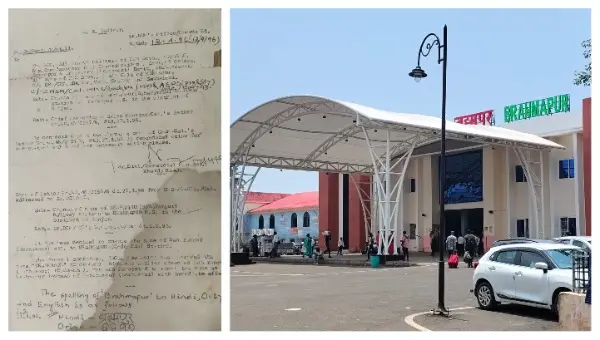
Brahmapur: Berhampur was officially renamed as ‘Brahmapur’ by the Indian Railways nearly 30 years ago, long before the Odisha government included the Silk City in its recent notification renaming 64 places across the state.
A rare official Railway document dated April 12, 1996 reveals that the South Eastern Railway had formally approved the change of the railway station’s name from Berhampur to ‘Brahmapur’ railway station with immediate effect. The decision followed approval from the Railway Board, and instructions were issued to all departments concerned to adopt the new name in English, Odia and Hindi.
The document also specified the official spelling of the station’s name in the three languages, marking the beginning of the city’s official identity as Brahmapur in Railway records.
Despite
the Railways adopting the new name in 1996, the Odisha government continued to use the old spelling, Berhampur, in its official records for nearly three decades. It was only recently that the state government formally changed the name to ‘Brahmapur’ as part of its notification renaming 64 towns and locations across Odisha.
The rediscovered Railway document underscores that the move to restore the city’s original name had already been implemented at the national level decades ago. The recent state government notification thus brings uniformity between Railway records and official state records, ending a long-standing difference in nomenclature.
The renaming of Berhampur to Brahmapur is a long-overdue correction, not a new name, many argued . They said that Brahmapur is the city’s original Odia name, while Berhampur was a colonial-era distortion.
Cultural activists said the change aligns English spelling with the correct Odia pronunciation and preserves the city’s heritage.
However, some questioned whether changing names should be a priority over infrastructure, employment, and public services. Concerns were raised about the expenses of updating signboards, records, and official documents. While restoring Brahmapur is historically and linguistically justified, they stressed that the government should ensure the symbolic exercise is accompanied by visible improvements in civic infrastructure, employment, and urban development.