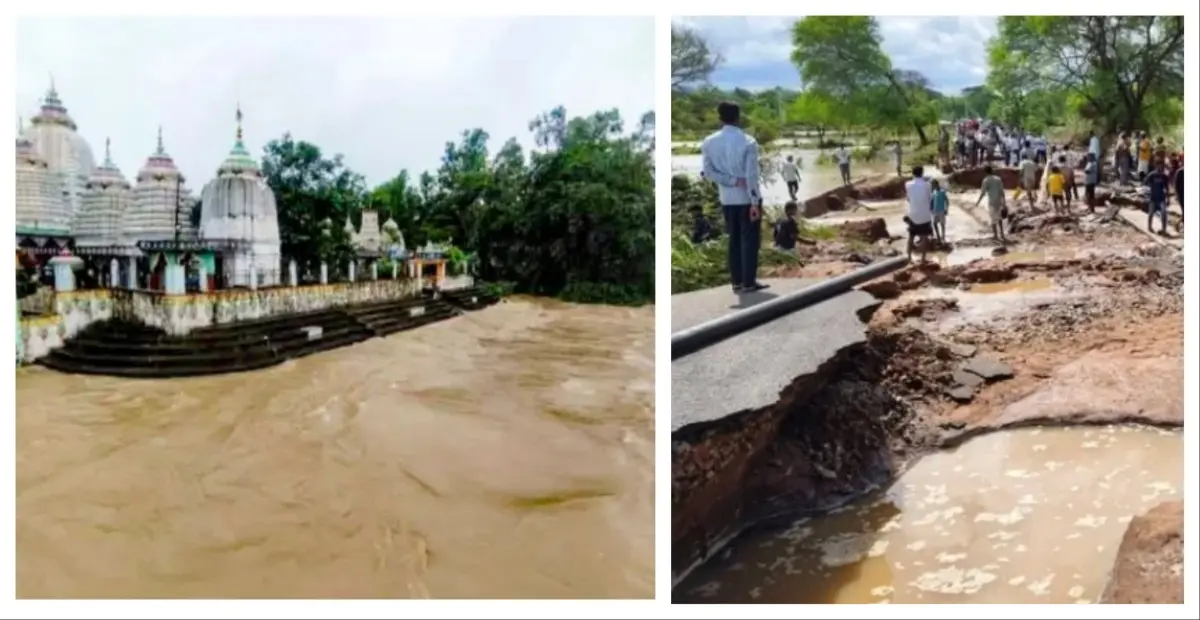
Bhubaneswar: Nearly six lakh people across five districts have been affected by the current floods in Odisha, Revenue and Disaster Management Minister Suresh Pujari said on Thursday.
He said districts such as Baleshwar, Jajpur, Bhadrak, Mayurbhanj and Kendujhar have been severely affected by incessant downpour and floods in different rivers.
The floods have affected 50 blocks, 356 gram panchayats, 1,084 villages, 11 urban local bodies (ULBs) and 169 wards across the state, Pujari told reporters after chairing a high-level review meeting in Bhubaneswar.
According to official data, as many as 5,87,822 people have been affected by the floods, while 1,76,073 people have been evacuated from vulnerable areas to safer locations. Around 21 villages remain marooned, including 17 in Baleshwar and four in Kendujhar.
Floodwaters have damaged 16,187 hectares of agricultural land, with Jajpur accounting for the highest crop loss at 11,497 hectares, followed by Mayurbhanj (3,754 hectares) and Kendujhar (936 hectares).
The floods have also damaged 1,020 houses, including 654 in Baleshwar, 278 in Mayurbhanj and 88 in Kendujhar.
The Minister 1.76 lakh people have been evacuated to safer locations as the government has set up 464 relief camps where basic facilities are being provided. People remaining in waterlogged areas are being supplied with dry food packets. He appealed to residents in low-lying areas to move to relief centres without delay.
The Minister all district collectors to ensure that every affected person receives proper care and relief materials.
He said the India Meteorological Department (IMD) has predicted a temporary relief after days of incessant rain, with no major rainfall likely in the state over the next three days. The flood situation is expected to improve gradually during this period, he said.
The Minister directed officials to prepare detailed damage assessment reports within three days of floodwater receding, asking them to conduct surveys with a humane approach and without worrying about the extent of losses.
Stressing that no one should be left out of government assistance, Pujari also directed collectors to persuade people in vulnerable pockets to shift to safer places and ensure protection of their homes with police deployment.
Additional Chief Secretary Arabinda Padhee said the reports should include details of crop losses, damaged houses and other destruction caused by the floods. Compensation will be released after the government receives and verifies the damage assessment reports, he said.
District collectors have been asked to submit reports on the extent of crop damage, houses affected and other losses within three days. Compensation will be provided based on these reports, Padhee said.
The Minister further asked officials to provide quality food, drinking water, healthcare, and security in all relief camps, with special attention to children and the elderly.
Special instructions were issued to prevent snakebite incidents by keeping adequate anti-venom stocks and deploying doctors in flood-affected areas. Families returning from relief centres will be provided tarpaulins and other essential materials.
The Minister made it clear that all possible steps must be taken on a war footing to safeguard human lives and provide timely relief to the affected population.
Meanwhile, Water Resources Department has warned that the flood discharge in the Mahanadi river system is expected to peak at 9.5 lakh cusecs at Mundali barrage near Kataka by Thursday evening.
Engineer-in-Chief of the Water Resources Department, Dillip Kumar Rout, said the flood situation is being closely monitored and described the expected peak as the largest flood event in the Mahanadi basin this monsoon season, though it is likely to remain a medium-level flood.
At 6 am, around 8 lakh cusecs of floodwater was passing through Mundali. The discharge remained steady at about 8.13 lakh cusecs for nearly four hours. By noon, it had increased to 8.28 lakh cusecs, and we expect the peak flow to reach around 9.5 lakh cusecs by evening, Rout said.
Though Odisha has experienced much larger floods in the past, including flows of 10 lakh and 12 lakh cusecs, the government is keeping a close watch on the situation, he said.
With discharge expected to cross 9 lakh cusecs, floodwaters are likely to spread across the Mahanadi and its distributary rivers, including the Luna, Karandia, Chitrotpala, Paika, Salia, Devi, Kandala, Kuakhai, Kushabhadra, Daya and Bhargavi.
Rout said the districts likely to witness the maximum impact are Khordha, Puri, Jagatsinghpur and Kendrapada. The priority is to ensure there is no breach in embankments and zero human casualties. Waterlogging in low-lying areas remains a concern and cannot be ignored, he said.
Experienced officials who have previously handled flood emergencies have been deployed in vulnerable districts to oversee flood management.
The state administration has intensified surveillance of embankments, evacuation preparedness and relief arrangements in vulnerable areas.
Regarding the water flow status of other rivers, Rout said floodwaters in the Baitarani River have started receding. The river had crossed its danger level of 18.33 metres, reaching 19.4 metres on Tuesday night. Though the water level has dropped by around 1.5 metres at Akhuapada, many villages continue to remain marooned due to slow drainage of floodwater caused by full moon.
The flood situation in the Salandi and Jalaka Rivers remains stable.