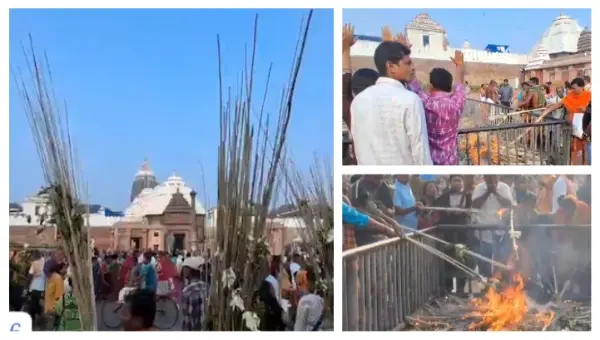
Bhubaneswar: A festival of lights, that’s the most common definition for Diwali, an undisputed belief across the lengths and breadth of India. But its religious significance isn’t limited to the homecoming of Lord Rama and his coronation as described in the Hindu epic of Ramayana. It varies across different communities. And Odisha’s ‘Diwali’ or ‘Deepavali’ has two aspects, distinctive and reimagined through Jagannath culture— ‘Bada Badua Daka’ or ‘Paya Shraddha’ and the celebrations at Shree Jagannath Temple in Puri.
In Hinduism, ‘Shraddha’ ritual lets the departed souls to transition to higher realms, facilitating eventual reincarnation. Paya Shraddha, popularly known as Bada Badua Daka, lends a distinct spiritual and cultural significance to Diwali celebrations in Odisha.
An integral part of Odisha’s ancestral worship traditions, ‘Paya Shraddha’ is among several forms of ‘Shraddha’ observed in the state, alongside ‘Mahalaya Shraddha’, ‘Pitru Paksha Shraddha’ and ‘Vaarshika Shraddha.’
The ‘Bada Badua’ chant on Paya Shraddha. It is believed that the occasion is observed by Lord Jagannath, along with lakhs of devotees, to pay homage to parents through a series of rituals. The Lords of Puri are adorned in Shraddha Besha, symbolising devotion and respect for ancestral divinity.
Paya Shraddha ritual on Diwali is woven around the “Bada Badua Daka”, a chant that roughly translates as ‘calling the ancestors’. Families light bundles of dried jute sticks or ‘Kaunria Kathi’ and wave them skyward to guide their departed ancestors (pitrus) back to the spiritual realm. “At dusk, the eldest son of each family walks to the courtyard, where tulsi (basil) plant is potted and holds a bundle of the dried jute stems. With the flame lifted towards the sky, the eldest son or a priest chants: Bada Badua Ho, Andhaare Aasi, Alore Jao, Ganga Jao, Gaya Jao, Baisee Pahache Gada Gadau Thaa (this shortened version of the chant is a pleading to the ancestors to come in dark but leave in light after gaining spiritual purification at in the holy waters of Ganga, at Gaya and by rolling on the sacred 22 steps of 12th-century shrine in Puri),” said Ritu Pattanaik, an author and culture enthusiast.
Besides the courtyard, people also perform ritual in the by-lanes of Puri, around Srimandir, and on the banks of ‘Bindu Sagar’ in Bhubaneswar. “If the eldest son is not available, families also engage priests to perform the ritual,” she added.
It is believed that the ancestors arrived under the shroud of darkness during Mahalaya and return along the sacred path of radiant light of the ‘Kaunria Kathi’.
According to reports, in southern Odisha, people—especially the Brahmin families—use sugarcane sticks, in place of the jute sticks, which are wrapped with ghee-dipped cotton wicks. The chant remains the same. Not much is known about the origin of this chant due to the lack of written records. But some trace it to the Panchasakha Era (15th–16th Century) of the legendary five saint-poets of Odisha—Balarama Dasa, Jagannatha Dasa, Achyutananda Dasa, Ananta Dasa, and Jasobanta Dasa, who democratised spiritual knowledge. Prior to this era, highly formalized Vedic ‘Shraddha’ rites were strictly the domain of Sanskrit-reading elites. The Panchasakha translated profound metaphysical truths into the vernacular Odia language, infusing local folklore like the ‘Bada Badua Daka’ with intense personal devotion (Bhakti).
Other historians connect it to the arrival of Chaitanya Mahaprabhu in Puri approximately 500 years ago during the Bhakti movement. He had fused ecstatic mass devotion with existing Odia customs. Under this wave, the ancestor-farewell ritual shifted from a fearful pacification of spirits into a deeply personal, loving act of filial gratitude and communal remembrance—the very definition of Bhakti.
Some also believe that the Diwali celebrations in the state date back to 350 BC. At that time, the Sadhabas — the merchant mariners of Kalinga — returned home from Bali, Java and Sumatra with ships full of wealth.
Celebrations at the Jagannath temple
At Shree Jagannath Temple, servitors also ascended the 200 feet high temple to lift the Mahadip and illuminate the temple “Amolaka” with diyas.