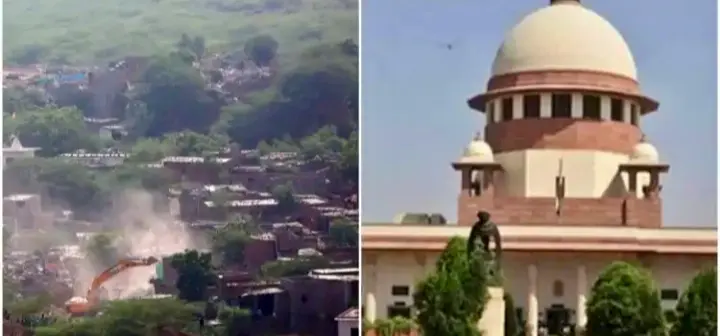
New Delhi: The Supreme Court will take a fresh look into the Aravalli issue after protests against a new definition of what constitutes the range. The matter is slated to come up for hearing on Monday.
Earlier this month, the Centre had notified a new definition based on a 100-metre height rule introduced by the apex court for identifying the hills. The notification said that any feature below 100 metres is not a part of the Aravalli. This has resulted in public outrage.
It has also come out now that an SC panel had also cautioned against renewal of mining leases within the mountainous terrain merely days before the SC order.
A three-judge bench headed by Chief Justice of India Surya Kant is now scheduled to hear the case, as reported by Financial Express after environmental groups like the Aravalli Virasat Jan Abhiyaan asserted that the new standard could allow extensive mining across Rajasthan, Haryana, and Gujarat. This will put the fragile ecosystem and millions of people’s water and climate at risk.
“There is nothing called sustainable mining in a critical mountain ecosystem like the Aravallis. You cannot define
the entire range for mining,” ANI has quoted activist Neelam Ahulwali as saying.
She also urged the Supreme Court to recall its earlier order and for the government to withdraw the new definition.
Financial Express had reported that the Central Empowered Committee (CEC) within the Supreme Court had first written to the court’s amicus curiae in October. The missive underlined the need to protect and conserve the ecology by sticking to a 3-degree slope benchmark outlined by the Forest Survey of India (FSI).
On November 7, the CEC reportedly recommended that the court not process 164 mining lease renewals in Rajasthan until a final, scientifically sound definition of the Aravalli range was approved. As per the CEC, almost all these leases came under areas earlier classified as the Aravalli hills by the FSI.
The CEC made this analysis by using satellite data and official mining records to show the potential overlap between the proposed mining areas and protected lands.
Despite these warnings, less than two weeks later, the Supreme Court accepted the 100-meter definition. Concerns were also raised that mining companies could soon be permitted to operate in earlier protected zones.
Environmentalists and the CEC have repeatedly highlighted the need for transparent data, public consultation, and scientific assessments before any changes are made.
Ahluwali has called for an independent study and an immediate stop to all mining near the forests, water sources, and villages until the concerns are addressed.