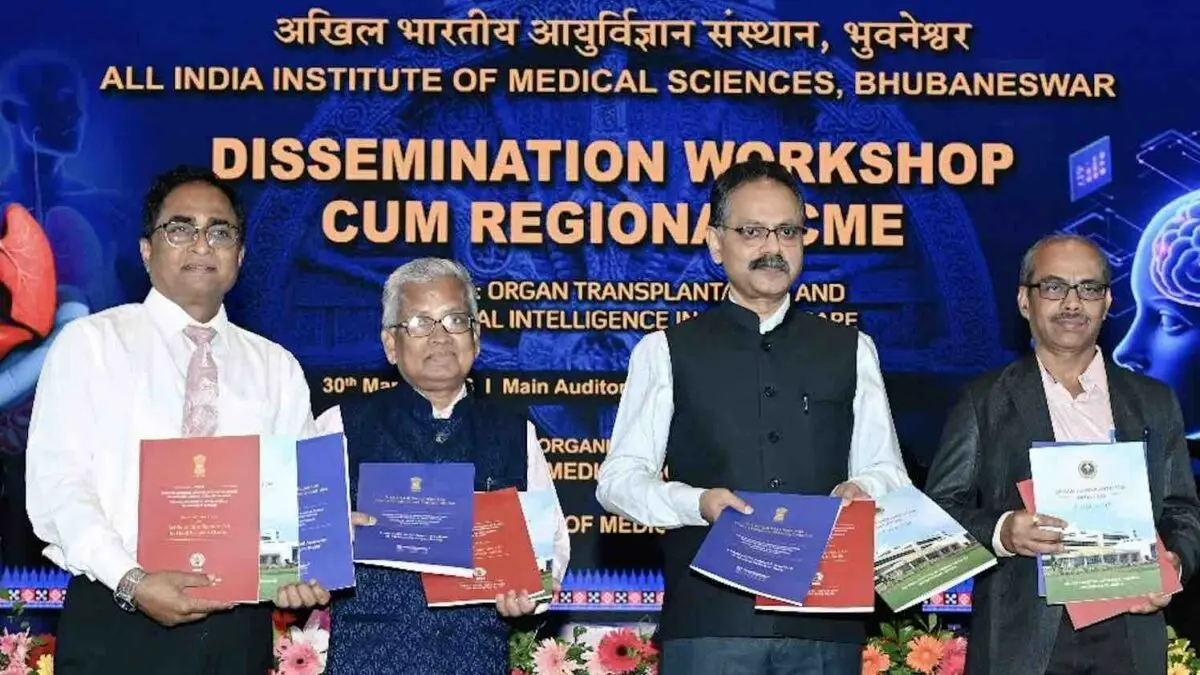
Bhubaneswar: Over 300 doctors from four eastern states gathered at AIIMS Bhubaneswar on Monday for a Regional Continuing Medical Education (CME) programme focused on organ transplantation and the growing role of Artificial Intelligence in healthcare.
The event, organised jointly by AIIMS Bhubaneswar and the National Academy of Medical Sciences (NAMS), highlighted how AI could revolutionise organ transplants and address India’s critical organ shortage.
The day-long workshop-cum-CME brought together medical professionals from Odisha, West Bengal, Bihar, and Jharkhand, including representatives from multiple AIIMS institutions. Eminent experts discussed ethical challenges, national guidelines, institutional preparedness, strategies to boost organ donation, and the application of AI in improving transplant outcomes.
The CME featured technical sessions by experts from IIT Bhubaneswar, PGIMER Chandigarh, NISER Bhubaneswar, and other premier institutions. Topics ranged from antimicrobial resistance in transplant patients to the role of AI in healthcare and practical strategies to promote organ donation.
AI as a Game-Changer for Organ Transplants
Addressing the inaugural session, Additional Secretary in the Prime Minister’s Office Subhasish Panda, emphasised AI’s transformative potential in organ transplantation. “AI co
uld be a way forward for organ transplant,” Panda said.
He explained that AI can integrate vast amounts of genetic, clinical, and laboratory data to improve donor-recipient matching, enable real-time tracking of available organs, optimise transportation routes for faster delivery, and support better decision-making through predictive analytics.
Panda noted that India ranks as the third leading country globally in organ transplantation, with approximately 20,000 transplants performed last year. However, he pointed out challenges: nearly 82% of donations come from living donors, with women forming the largest donor group, and a significant portion of transplants occurring in the private sector, which limits affordability for many patients.
He called for greater public awareness and stronger participation from government institutions to expand the donor pool.
Major Announcements and Ground Realities
Executive Director & CEO of AIIMS Bhubaneswar Ashutosh Biswas announced that the institute plans to establish a regional centre of excellence dedicated to organ transplantation and artificial intelligence. He stressed the need to expand donor pools and strengthen institutional readiness in line with national policies.
President of NAMS Digambar Behera highlighted the severe demand-supply gap in organ transplantation. “India needs nearly 5 lakh organs annually, yet only about 3% of this demand is currently met, leaving over 82,000 patients on active waiting lists,” he said.
The programme concluded with a strong consensus on the need for enhanced collaboration among institutions, increased public awareness campaigns, and greater use of artificial intelligence to bridge gaps in organ transplantation across the country.