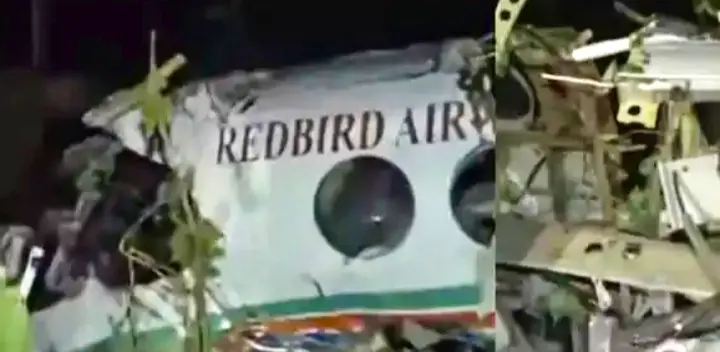
Ranchi: The ill-fated air ambulance that crashed in Jharkhand on Monday evening, killing all seven people on board, did not have a black box, making it difficult for investigators to ascertain the exact cause of the accident.
The absence of a black box was not due to a lapse on the part of the operator though. It was not mandatory for aircraft of that class to be fitted with the device at the time it received its Certificate of Airworthiness (CoA).
A black box – actually orange in colour – comprises of a Flight Data Recorder (FDR) and a Cockpit Voice Recorder (CVR). After any incident involving an aircraft, investigators can piece together the events that took place.
According to the Aircraft Accident Investigation Bureau (AAIB), a team of which is camping at the crash site to collect samples, the aircraft’s first CoA was issued in 1987, as reported by Republic TV.
Turbine-engined aircraft with a maximum take-off weight of 5,700 kg or less are required to be fitted with a CVR only if their individual airworthiness certification was issued on or after January 1, 2016, as per Civil Aviation Requirements (CAR).
Installation of an FDR is mandatory for aircraft of that weight category only if certified on or after January 1, 1990.
The aircraft that crashed, a Beechcraft C90, was manufactured in 1987. It had a maximum take-off weight of 4,583 kg. The date of manufacture predated both regulatory cut-off dates. As a result, there was no statutory requirement for either a CVR or FDR.
It
has also come to light that the aircraft had remained unused between 2018 and 2022, before being acquired by Redbird Airways.
Investigators will likely crosscheck details regarding maintenance of the aircraft, and airworthiness clearances issued prior to its return to service.
According to the report, investigators are also examining whether the onboard weather radar functioned properly during the flight. It is being checked whether any kind of malfunction affected the performance of the radar or whether the crew may have misinterpreted radar readings while navigating through storm activity along the route.
Two commercial flights operating in the same route earlier had reportedly requested deviations due to weather conditions. The air ambulance had also sought a route deviation before disappearing from radar screens.
The chartered air ambulance crashed in Jharkhand’s Chatra district after losing contact with Air Traffic Control (ATC) shortly after taking off from Ranchi’s Birsa Munda Airport. The aircraft was en route to Delhi and was carrying seven people, including a patient, a doctor, a paramedic, two attendants, and the pilot and co pilot. There were no survivors following the crash.
Air traffic sources said that the pilot requested for a reroute around 10 minutes after takeoff owing to adverse weather conditions and low visibility. Between 7.20 pm and 7.21 pm, the pilot requested diversion from ATC. The last radio contact was recorded at 7.34 pm with Kolkata Area Control, after which the aircraft disappeared completely from radar.
Debris was later discovered near Simaria in Chatra district confirming the crash
The aircraft lost radar contact after deviating from its intended route, the Directorate General of Civil Aviation confirmed. The Rescue Coordination Centre in Kolkata was activated at 8.05 pm, and local authorities were alerted for search and recovery operations.