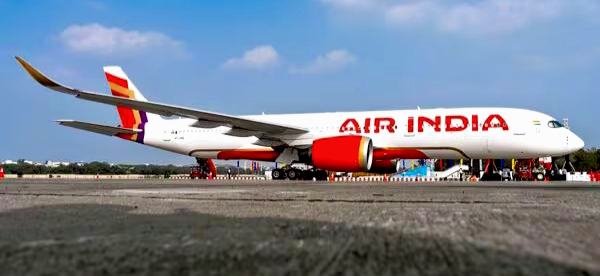
New Delhi: The Aircraft Accident Investigation Bureau (AAIB) has blamed human error and lack of infrastructure at the airport for the December 2024 aborted take-off of an Air India flight from Goa. The final report on this incident was released on Monday.
The aircraft – an Airbus A320 – was rolling down a taxiway at 124 knots (about 230 km/hr) when the Air Traffic Control (ATC) ordered the pilots to abort take-off. The AAIB declared it as a serious incident after it came to be known that the aircraft was not on its assigned runway, even as it was gaining speed for take-off. A major disaster could have occurred had the take-off not been aborted at the last minute. The pilots would not have been able to abort had the speed crossed 140 knots.
The incident involved Air India flight AIC 2592 from Goa to Hyderabad. The plane was carrying 151 passengers and 7 crew members on the evening of December 5, 2024 when the take-off was aborted around 9.17 pm. Visibility was 3,000 metres when the ATC realised that the flight had mistakenly entered Taxiway ‘A’ instead of Taxiway ‘A5’, which had been assigned for take-off on Runway 28.
The probe report states that there was a ‘Situational Awareness Deficit’ on the part of the crew. The clearance given by the ATC likely caused the crew’s cognitive focus to shift entirely towards the take-off.
“This shift may have diminished their situational awareness, resulting in expectation bias or cognitive overload, which prevented them from recognising the visual cues indicating they were at the taxiway intersection instead of the runway intersection,” the report stated.
“Had the crew followed the correct instructions and entered TWY A5 before turning for line-up, the incident could have been avoided,” it added.
Several other factors also contributed to the incident. The airport did not have an Advanced Surface Movement Guidance and Control System (A-SMGCS), which could have improved crew awareness. Meanwhile, the co-pilot was preoccupied with troubleshooting the Electronic Flight Bag (EFB), which had gone into sleep mode. The EFB displays a dynamic map showing the aircraft’s real-time position using data from the Flight Management System.
“The co-pilot was trying to restore the EFB display to ON mode to initiate the LINE-UP checklist. During this time, he failed to verify the departure runway while the flying pilot was incorrectly lining up on Taxiway A,” the report said.
The AAIB has recommended that the Airports Authority of India consider installing an A-SMGCS system at the Goa airport. It has also suggested that Air India and the Directorate General of Civil Aviation (DGCA) coordinate with IT teams to prevent EFB systems from entering sleep mode during critical operations.
“All airline operators should encourage cockpit crews to cross-check their aircraft’s position using the Aircraft Moving Map alongside primary navigation tools before take-off,” AAIB has recommended.