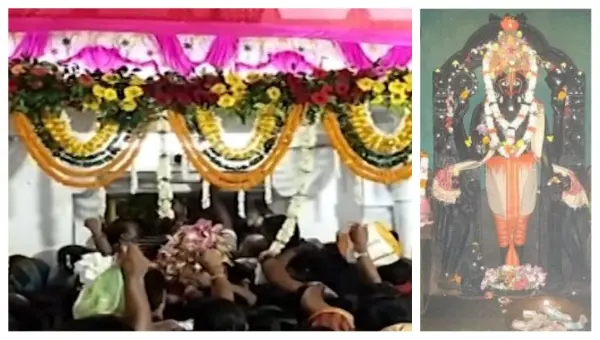
Brahmagiri: Following the grand celebrations of DevasSnana Purnima at Shree Jagannath Temple in Odisha’s Puri, Alarnath Temple in Brahmagiri has transitioned into a bustling hub for millions of devotees.
This sudden surge in pilgrims marks the beginning of Anasara period during which Lord Jagannath and his siblings are believed to fall ill and remain out of public sight.
Despite overcast skies and intermittent rainfall, thousands of emotional devotees were seen standing in long queues on Tuesday, holding tulsi leaves and flowers, waiting to offer their prayers at the alternative home of the Lord.
The Divine Sickness and the Alarnath Connection
On Devasnana Purnima, the sibling deities underwent a ritualistic grand bath with 108 pots of aromatic, sanctified water. According to centuries-old tradition, this excessive bathing causes the deities to catch a high fever. They are subsequently moved to a secluded sick room called the Anasara Pindi for 15 days to recuperate under the care of traditional healers as per the traditions and rituals on the premises of the 12th-century shrine in the pilgrim town.
With the main temple doors in Puri closed to the public, spiritual focus shifts entirely to this small temple at Brahmagiri, about 23 km from Puri. Devotees strongly believe that catching a glimpse of Lord Alarnath during this period brings the exact same spiritual merit
(punya) as witnessing Lord Jagannath himself in Puri. This deep-rooted tradition traces back to the era of the saint Sri Chaitanya Mahaprabhu, who had elaborately mentioned in his writings that he visualised manifestation of Lord Jagannath in Alarnath while camping here along with his followers in 1610 AD.
Along with Lord Alarnath, the devotees also offer prayers to Lord Ananta Basudev and Devi Bhubaneswari, considered as incarnations of Lord Balabhadra and Devi Subhadra. The idols of Lord Dolagobinda, Lord Nrusingha, Lord Madanmohan, Lord Rama, Lord Krishna, Goddess Bhudevi, Goddess Sridevi and the 10 incarnations of Lord Vishnu are also worshipped at the Alarnath peeth.
Distribution of ‘kheer bhog’, which is prepared with buffalo milk and blended with other ingredients, and cooked ‘prasad’ at the temple, also attracts scores of pilgrims.
Anticipating a heavy footfall of local and out-of-state tourists, seven platoons of police forces have been heavily deployed across the temple premises to regulate incoming queues. Over 50 CCTV cameras have also been strategically installed to closely monitor the crowd.
Also Read: Heavy Vehicles Banned On 2 Key Puri-Brahmagiri Routes For Anasara Period
LEGENDS
Lord Brahma came down to this place and worshipped Lord Vishnu. Pleased with his devotion, Lord Vishnu asked him to carve out a four-handed deity of black stone, carrying a sankha, chakra, gada and padma in each hand. The hill was called Brahmagiri since Brahma had worshipped him there.
The temple is believed to have been built by the rulers of Alwar, Rajasthan; hence the name Alwarnath or Alarnath.
In around 1610 AD, Chaitanya Mahaprabhu visited Puri and was unable to have darshan of the sibling deities since they were recuperating at the Anasara Ghar. It was then that the Lord came in the saint’s dream and directed him to the Alarnath temple.
On reaching Brahmagiri, he could see Lord Jagannath in the black idol of Vishnu. As he did a sastang pranam (full body on the floor), the stone underneath melted. The stone bearing the body impressions of Chaitanya Mahaprabhu can still be found today.