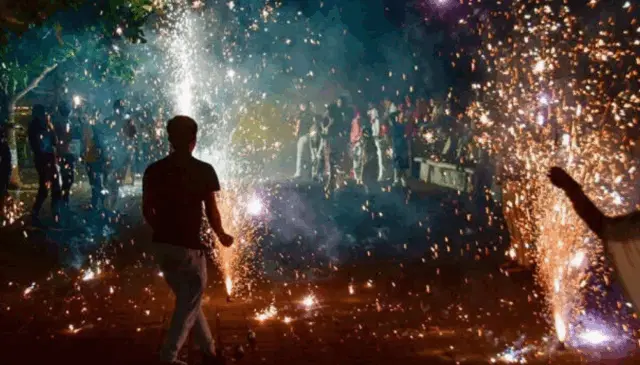
Bhubaneswar: With less than a week to go for Diwali, preparations for the festival of lights are gathering pace. However, alongside the festive excitement, concerns over the environmental impact of firecrackers are once again coming to the forefront. While fireworks have traditionally been associated with the celebrations, the smoke and particulate emissions they release can significantly deteriorate air quality, posing health risks to vulnerable sections of society.
With concerns over rising levels of PM2.5 and PM10 particles and the possibility of the Air Quality Index (AQI) crossing 300 during the festive period, environmental experts are encouraging people to rethink conventional celebrations and adopt more sustainable alternatives.
Niranjan Mallik, an environmental scientist with the Odisha State Pollution Control Board, said, “People should make a conscious effort to minimise the use of conventional firecrackers and opt for certified green crackers wherever necessary. Celebrating Diwali with traditional earthen lamps instead of excessive fireworks can go a long way in reducing the environmental impact of the festival.”
Understanding the difference: What makes a cracker ‘green’?
Conventional firecrackers release a combination of harmful pollutants when ignited, including fine particulate matter, sulphur dioxide, nitrogen dioxide and metallic particles. These emissions contribute to deteriorating air quality and can have adverse effects on human health.
To address this concern, the Council of Scientific and Industrial Research–National Environmental Engineering Research Institute (CSIR-NEERI) has developed the concept of green crackers. These are designed using modified chemical formulations to reduce the release of particulate pollutants compared with conventional fireworks. According to them, green crackers are designed to achieve at least a 30 per cent reduction in particulate emissions. Certain harmful chemical ingredients, including barium nitrate, are restricted in their formulations.
However, Mallik cautions against treating green crackers as completely pollution-free alternatives. Although they generate comparatively lower emissions, they still release pollutants and contribute to noise and air pollution. Their use, therefore, should not be seen as a substitute for responsible celebration.
Don’t be misled by the ‘Green Cracker’ label
One of the major challenges facing consumers is the availability of firecrackers being marketed as green products without necessarily meeting the prescribed standards.
Mallik advises buyers to verify the authenticity of such products before making a purchase. Consumers should check the relevant CSIR-NEERI certification and registration details, ensure that the manufacturer has the necessary Petroleum and Explosives Safety Organisation (PESO) authorisation, and scan the QR code provided on the packaging. Certification is product- and manufacturer-specific. Therefore, simply displaying the words ‘Green Crackers’ on a packet does not establish that the product is genuine or approved. Greater consumer awareness and verification are essential to prevent misleading claims.
The invisible health cost of fireworks
Beyond the visible smoke and noise, the fine particles released by fireworks pose a significant public health concern. PM2.5 particles are particularly dangerous because of their extremely small size, allowing them to penetrate deep into the lungs. PM10 particles can also irritate the respiratory system and aggravate existing health conditions.
Exposure to these pollutants can trigger coughing, breathing difficulties, eye irritation and other respiratory symptoms. The risks are particularly high for children, senior citizens and individuals with pre-existing respiratory or cardiovascular conditions. The impact of firecracker pollution may also extend beyond Diwali night, as accumulated particulate matter can continue to affect ambient air quality after the celebrations have ended.
Safety must remain a priority
Alongside environmental concerns, Mallik has stressed the importance of following basic firecracker safety precautions to prevent accidents and injuries. People should strictly adhere to the timings and restrictions prescribed by the local administration. Children below the age of 10 should be kept away from firecrackers, while those participating in celebrations should wear cotton clothing and maintain a safe distance from ignition points. Responsible handling, adult supervision and compliance with local safety guidelines are equally important to ensure that festive celebrations do not turn into emergencies.
A celebration that respects the environment
Diwali symbolises the triumph of light over darkness. Yet, the true spirit of the festival need not be defined by the number of fireworks illuminating the sky. Lighting traditional diyas, decorating homes and neighbourhoods, and avoiding unnecessary smoke and noise can make the celebrations more meaningful and environmentally responsible.
Mallik believes that environmental protection cannot remain the responsibility of government agencies and pollution control authorities alone. Individual choices and collective public participation are equally important in reducing pollution. As the city prepares for another Diwali, the message is simple: celebrate the festival with light, not excessive smoke. A conscious shift towards traditional lamps and responsible festive practices can help protect public health while preserving the joy and spirit of the occasion.