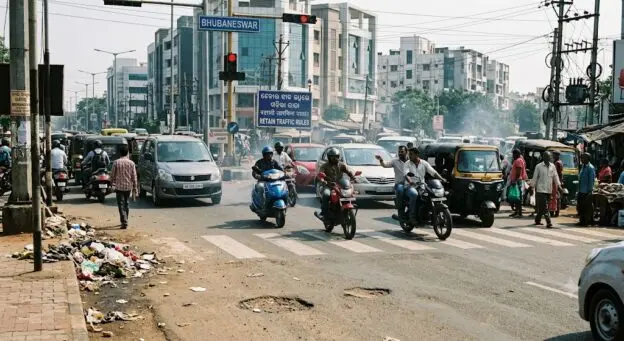
To navigate an Indian street is to witness a profound, multi-layered behavioural crisis. On any given afternoon in Bhubaneswar, wrong-side driving, red-light jumping, and open hostility among commuters are regular occurrences. The physical reality of chaotic traffic is a visible symptom of deep-rooted psychological, historical, and economic dynamics. It presents a critical challenge to the country’s social fabric.
This persistent disorder stems from several distinct foundational factors, beginning with an educational and institutional gap. Formal driver education is severely lacking, and basic road responsibility is rarely taught at home or in schools, leaving operators without a fundamental understanding of traffic rules or defensive driving ethics. Furthermore, as a relatively young country approaching its eighth decade of independence, the population is still adjusting to the strict civic structures required by dense urban spaces.
Compounding this transition in expanding cities like Bhubaneswar is a unique sociological layer. A large portion of commuters are second or third generation urban residents coming from rural environments. They carry an unconditioned, informal mindset where unstructured movement is normal, mistakenly viewing strict traffic laws as unnecessary hurdles rather than civic baselines. This is further aggravated by the psychology of ingrained poverty.
Decades of navigating systemic resource scarcity have created an anxious, deeply competitive mindset. This creates an unyielding hurry, leading individuals to cut corners and bypass traffic rules to avoid being left behind. Because the education system prioritises intense hyper-competition over civic cooperation or social responsibility, citizens are poorly equipped to follow collective rules when individual convenience is at stake.
Most critically, this street-level chaos exposes a deeper, more unsettling truth: a near-total absence of authentic nationalism among the population, substituted instead by a hollow, performative passion reserved for cricket matches or televised spectacles. True nationalism demands a collective ownership of public property, yet national infrastructure like roads and streets are routinely treated as dump yards for garbage. Public spaces are aggressively exploited a
nd then abandoned, treated as someone else’s responsibility to clean.
This complete lack of civic ownership is paired with an absolute deficit of consideration for fellow citizens. There is zero empathy or sympathy on the asphalt; the shared public square has become a site of aggressive competition rather than mutual respect.
Entrenched corruption across various enforcement levels further compromises effective deterrence, enabling a culture of political entitlement where individuals use proximity to power as a shield to bypass accountability entirely. The consequences of this pervasive civic lawlessness extend far beyond daily inconvenience into a severe human and economic crisis.
According to the Ministry of Road Transport and Highways (MoRTH), India recorded a staggering 1,77,175 road accident fatalities and 4,71,441 injuries annually. Human error and safety violations, such as speeding and wrong-side driving, account for over 70% of these fatal crashes.
In Odisha, state police statistics reveal an equally grim reality: road accidents claim nearly 6,500 lives every year, averaging out to 18 preventable fatalities every single day on state roads. The World Bank estimates that road traffic injuries cost the Indian economy between 3% to 5% of its Gross Domestic Product (GDP) annually, representing an immense drain on national productivity and a massive loss of working man-days. Because over 80% of these fatalities occur within the productive working-age group of 18–60 years, the sudden loss of a primary breadwinner frequently drives lower- and middle-class families into severe, generational financial crises.
The legal framework to address this crisis already exists within the Motor Vehicles (Amendment) Act, 2019, which significantly increased penalties for traffic violations. However, legislation without enforcement cannot change public behaviour.
Reversing this slide requires strong political will and innovative, self-sustaining systemic checks to remove human bias. The state must introduce crowd sourced civic enforcement, empowering citizens to securely upload photographic or video evidence of any kind of traffic violation. By creating remuneration loop where contributing citizens are financially rewarded directly from the digital fines automatically levied on the violator, the balance of power shifts from the aggressive violator back to the community. Paired with automated, contactless traffic systems modelled after international standards like Singapore, the system ensures uniform accountability shielded from
political interference.
Bhubaneswar stands at a critical juncture; restoring order requires an honest admission that true strength lies not in raw displays of power or performing false nationalism, but in an unwavering commitment to the rule of law.
(Views expressed by the columnist are personal and do not necessarily reflect the opinion or policy of the news portal)