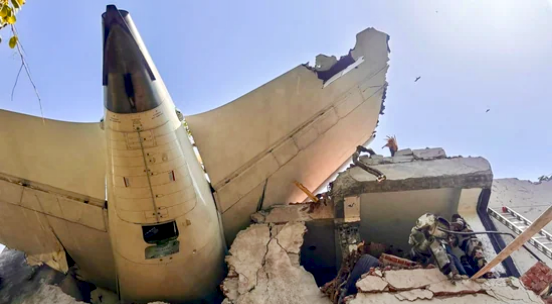
New Delhi: Is the US Federal Aviation Administration (FAA) attempting to influence the Investigation into the Air India crash in Ahmedabad that is being conducted by the Airline Accident Investigation Bureau (AAIB)?
FAA head Bryan Bedford has come under fire from several quarters after giving Boeing a clean chit and saying that a mechanical failure did not appear to have caused the 787-8 Dreamliner (AI171) disaster.
Bedford also discounted “inadvertent manipulation” of the fuel control switches. By this, he has again shifted the blame of intentionally cutting off the fuel switches on one of the pilots of the ill-fated aircraft.
“We can say with a high level of confidence that it doesn’t appear to be a mechanical issue with the Boeing fuel control unit,” Reuters quoted Bedford as saying on the sidelines of an air show in Wisconsin, USA.
“We feel very comfortable that this isn’t an issue with inadvertent manipulation of fuel control,” he added.
Bedford apparently cited an evaluation conducted by FAA employees who examined aircraft (not the one that crashed), took out the units and tested them and had inspectors get into the cockpits to review them.
C S Randhawa, president of the Federation of Indian Pilots (FIP) and some aviation experts have questioned the propriety and credibility of Bedford’s comments when the probe was continuing and wondered if this is an attempt to influence the investigation. Randhawa pointed out that the FAA is not the investigating agency.
“The FAA is not the investigative authority (and cannot) clearly stipulate that there is no technical issue. As long as the investigations are going on, it’s strange to come to conclusions,” Randhawa told The Telegraph.
“I strongly believe there was an electronic problem with the Thrust Control Malfunction Accommodation (TCMA) or the electronic engine control (EEC),” he said.
The TCMA is a safety system designed to detect and correct thrust control malfunction, while the EEC controls and optimises engine performance and efficiency.
Even the National Transportation Safety Board (NTSB) of the US – that is assisting in the probe – has urged people not to make speculative and irresponsible comments on the issue.
While Air India did not comment on the matter, Boeing said: “We’ll defer to the FAA for any comments on this.”
AAIB’s preliminary report had indicated that the fuel control switches of AI171 had flipped from “run” to “cut off” seconds after the lift-off from Ahmedabad, starving both engines of fuel. The flight data recorder revealed one of the pilots asking the other why he ‘switched off’ and the other responding with ‘i did not’.
The Ministry of Civil Aviation made it clear that the report is a preliminary one and is inconclusive, urging all not to get speculative about the actual cause of the crash that occurred 32 seconds after lift-off, killing 241 people on board and 19 on the ground.
“It’s unfortunate that the administrator of FAA has himself opted to pre-empt the inquiry by making this very public statement at an air show in Wisconsin,” aviation expert and chairperson of the International Foundation for Aviation, Aerospace and Drones Sanat Kaul told The Telegraph.
“If it’s a manufacturing issue, then Boeing along with its suppliers will be held responsible and it would lead to huge damages and loss of reputation,” Kaul added.
He cited a report about how the fuel switches of a Boeing 787-8 Dreamliner, operated by Japanese airline ANA, had got cut off automatically on landing at Osaka airport in 2019. “It did not lead to an accident but it was a software glitch,” Kaul said.