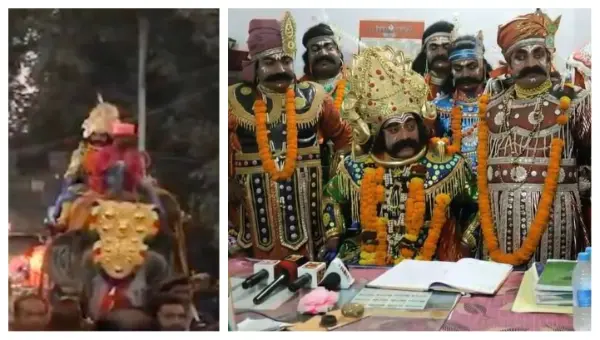
Bhubaneswar: In a colourful display of tradition and satire, demon king Kansa at the ongoing Bargarh Dhanu Jatra on Sunday slapped a symbolic penalty of 12 lakh gold coins on the Transport department after inspecting civic amenities in the western Odisha town.
As part of the festival’s “Nagar Parikrama” (town tour) — a citizen-outreach programme where Kansa “rules” over Bargarh transformed into ancient Mathura — the king summoned officials from the Transport Department and expressed strong displeasure over poor sanitation and inadequate facilities at the government bus stand.
He drew the department’s attention to heaps of garbage, dilapidated toilets, and a lack of passenger amenities. The fine was broken down into 7 lakh gold coins for poor sanitation and overall inadequate maintenance, with an additional 5 lakh for the
officials’ delay in appearing before him. “I received numerous complaints from citizens about the sorry state of the Bargarh bus stand. Upon inspection today, I found the conditions unacceptable and have fined the officials accordingly. They must also act swiftly to curb drunk driving,” declared Kansa Maharaj in his characteristic dramatic style.
This playful yet pointed critique is a hallmark of the Dhanu Jatra, where the character of Kansa — traditionally a tyrant in Krishna lore — ironically becomes a vigilant ruler highlighting real-world civic issues.
The world-famous Bargarh Dhanu Jatra, recognised as the largest open-air theatrical festival, transforms the town and surrounding areas into a sprawling stage reenacting episodes from Lord Krishna’s life, culminating in Kansa’s death.
The 11-day event kicked off on December 24 and will run until January 3, 2026, drawing thousands of visitors to witness over 3,000 artistes performing across multiple venues without a fixed script.
Supported by a state government grant and emphasising Odisha’s cultural heritage, the festival continues to blend mythology, satire, and community engagement, reminding authorities of public grievances in the most theatrical way possible.