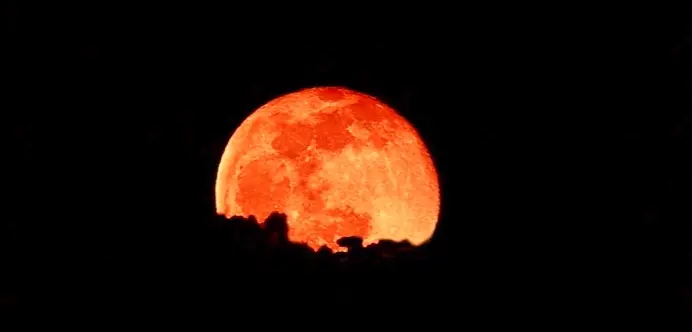
New Delhi: There is a special treat in store for skywatchers in India tonight. A total lunar eclipse is set to grace the night sky, painting the Moon in shades of deep red.
Referred to as a “Blood Moon”, this phenomenon will last for an impressive 82 minutes, making it one of the longest total lunar eclipses of the decade.
A total lunar eclipse occurs when the Earth moves directly between the Sun and the Moon, casting its shadow upon the lunar surface. Unlike a solar eclipse, which briefly darkens the day, the lunar eclipse gives the Moon a reddish glow.
This happens because sunlight skims through the edges of Earth’s atmosphere, scattering shorter wavelengths like blue and green, while bending and projecting the longer red wavelengths onto the Moon.
On Sunday evening, the Moon will appear dramatically red to observers across the globe for 82 minutes. During this time, the contrast between the dim, copper-hued Moon and the surrounding stars will be breathtaking, offering astronomy lovers and casual stargazers alike a memorable sight.
According to astronomers, the whole phenomenon will be visible from nearly all parts of India from start to finish. The total phase, when the Moon appears completely red, will begin late in the evening and continue past midnight, they say.
While the entire event, including the partial and penumbral phases, will last for several hours, it will be the 82-minute “blood red” stage that will be the most dramatic.
People in major cities across India, including Delhi, Mumbai, Bengaluru, Chennai, and Kolkata will have an excellent view, provided the skies are clear.
The eclipse will be visible to nearly seven million people living on several continents. People in Yangon, Shanghai, Johannesburg, Lagos, Cairo, Bangkok, Jakarta, Berlin, Moscow, Seoul, Rome, Dhaka, Kolkata, Budapest, Manila, Athens, Singapore, Melbourne, Bucharest, Sydney, Sofia, Tokyo, Beijing, Ankara, Brussels, Amsterdam, Paris, London, Madrid, will have the best view, astronomers said.
Unlike solar eclipses, lunar eclipses do not require any special protective glasses, making it safe to watch with the naked eye or through a telescope.
Such long-duration total lunar eclipses are infrequent. The Moon turning a vivid red for more than an hour is not just a spectacle of nature but also a reminder of our planet’s unique place in space.
For photographers, the event is a golden opportunity to capture stunning images, while for students and sky enthusiasts, it offers an ideal moment to learn more about celestial mechanics.