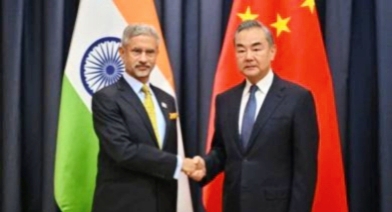
New Delhi: China is working towards addressing New Delhi’s concerns about the export restrictions on fertilisers and rare earth minerals, the country’s foreign minister Wang Yi told India’s external affairs minister S Jaishankar on Monday.
Yi, who is on a two day visit to India, will meet National Security Adviser Ajit Doval under the Special Representatives mechanism on Tuesday.
China has apparently promised to address three key concerns of India related to export restrictions imposed by Beijing in recent months.
“Yi assured the external affairs minister that China is addressing India’s needs for fertilisers, rare earth minerals and tunnel boring machines,” an official said.
Jaishankar had said on Monday that he raised “particular concerns” with Yi which had also figured in their last meeting in July.
In the July meeting, Jaishankar had said the two sides should avoid “restrictive trade measures and roadblocks” to economic cooperation. He was referring to China’s curbs on exports of rare earth minerals – used in everything from smartphones to electric vehicles and in many of which Beijing has a near monopoly – and fertilisers. The restrictions on rare earth exports have impacted Indian manufacturers of electric vehicles.
Fertilisers are also a major issue. In 2023, nearly half of China’s fertiliser exports came to India. In 2024, China halted exports to all countries. This ban was relaxed in June, but restrictions against India continue.
According to the Fertiliser Association of India,India’s imports of urea from China fell to about 100,000 tonnes in 2024-25, as compared to 1.87 million tonnes in the previous fiscal. To handle the shortfall, India finalised a long-term agreements with Saudi Arabia for 3.1 million metric tonnes of Di-ammonium phosphate or DAP per annum for five years in July. DAP is the second most widely used crop nutrient in India.
The issue of three large tunnel boring machines, the export of which China has also held up, was also discussed. These TBMs are needed for a 21-km underground section of the Ahmedabad-Mumbai high-speed rail project. They were to have reached India between October 2024 and early this year.
Jaishankar told Yi on Monday that India and China need a “candid and constructive” approach based on mutual respect and mutual sensitivity to drive their relations after a difficult period. He reiterated India’s call to take forward the de-escalation process along the Line of Actual Control (LAC).
The two sides discussed economic and trade issues, river data sharing, border trade, connectivity, and bilateral exchanges at the meeting.
Yi is the first Chinese minister to travel to India since the two sides reached an understanding last October to end the military standoff on the LAC that began in April-May 2020. The face-off and a brutal clash in Galwan Valley in June 2020 took bilateral ties to a six-decade low.
On Tuesday, Yi is expected to meet Prime Minister Narendra Modi after his meeting with Doval.
It’s visit is significant because of the geopolitical and economic flux created by the policies of the Donald Trump administration in the US. Both Jaishankar and Yi referred to this in their opening remarks at their meeting.
Jaishankar said India and China seek a fair, balanced, and multipolar world order, including a multipolar Asia. “In the current environment, there is clearly the imperative of maintaining and enhancing stability in the global economy as well,” he said.
Yi said “unilateralism is running rampant” and “free trade and the international order are faced with severe challenges”. India and China, as the two largest developing countries, should shoulder the responsibility of seeking “strength and dignity” for developing countries, he said.
The thaw in bilateral relations has led to India and China resuming the Kailash Mansarovar Yatra to the Tibet region after five years. India has resumed tourist visas for Chinese nationals for the first time since 2020, and the two sides are in advanced negotiations to resume direct flights and border trade.