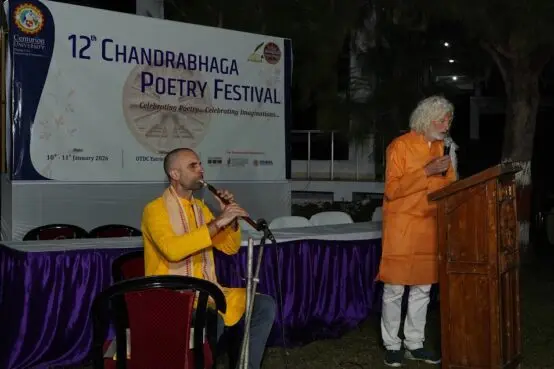
Puri: For over a decade, a committed circle of poets from across India and the world has converged annually on the tranquil banks of Odisha’s Chandrabhaga river, in the shadow of the iconic Konark Sun Temple—a monument where poetry seems eternally etched in stone.
In an era when literary festivals have proliferated like mass-market products, endlessly pursuing sponsors, celebrity draw, and commercial success, this gathering remains distinctly different.
Poetry, in many such events, is repackaged for instant gratification, stripped of depth for viral moments.
Yet Chandrabhaga Poetry Festival endures, quietly and purposefully, as a rare space that prioritizes the authentic, the unpolished, and the urgent. It remains an oasis for voices from the margins—the unheard, the resistant, and the nonconformist.
Here, poetry emerges not from polished stages but from the innermost wounds of society. Poets become conduits for the silenced: Dalits, Adivasis, women, transgender individuals, and linguistic and religious minorities. Far from a star-studded extravaganza, the participants are everyday people standing as equals, sharing poetry as effortlessly as everyday conversation.
The festival’s latest edition unfolded on January 10-11 in Konark, with logistical support from Centurion University, Bhubaneswar. At its core, however, it is sustained by a dedicated collective of writers who deliberately shun state patronage or corporate backing. This independence preserves its spirit: an alternative to the commodified literary circuit, rooted in solidarity, resistance, and genuine exchange.
Honouring Jayanta Mahapatra’s Enduring Legacy
The festival draws profound inspiration from the legacy of Jayanta Mahapatra, the pioneering Indian-English poet whose work bridged pe
rsonal introspection with Odisha’s cultural and social landscapes. Prof. Manoranjan Mohanty, an eminent social scientist, stated during the occasion that Chandrabhaga pays tribute to Mahapatra’s vision through its focus on amplifying marginalized voices.
Poets from such communities read their work and engage in open dialogue, fostering empathy and understanding across divides.
Unlike mainstream festivals that elevate “stars,” this one dissolves hierarchies—poets sit among attendees, part of the common fabric of life, their words a shared human breath rather than a performance.
An Evening of Transcendent Poetry & Music
One of the festival’s most memorable moments came during an evening session that transcended language and borders. French poet Yves Ouallet (also known as Quallet Yves in some festival records) delivered a selection of his profoundly mystic and lyrical poems. His delivery was mesmerizing, weaving introspection with cosmic wonder. Complementing Ouallet’s verses was French musician Sevan Arevian, who accompanied him on the duduk, an ancient Armenian woodwind instrument, evocative and haunting, blending the ethereal breathiness of a flute with the soulful resonance of a shehnai. The fusion created something almost other-worldly: poetry and music merging into a seamless, meditative experience. As Ouallet evoked the vast cosmic void and the enigmatic cycles of existence, the words hung in the air, elevated by the duduk’s mournful, soaring tones.
In that moment, poetry achieved purity—distilled into near-silence through profound musicality. It reminded us that true verse can transcend the spoken word, becoming a quiet elevation of the spirit, a shared communion under the Konark sky.
In an era of noise and spectacle, Chandrabhaga Poetry Festival persists as a quiet rebellion: a reminder that poetry’s power lies not in acclaim, but in its capacity to heal wounds, bridge divides, and illuminate the human condition from the edges inward. Year after year, it reaffirms that an alternative is not only possible—it is essential.
(The views expressed in the article are those of author and not necessarily the company)