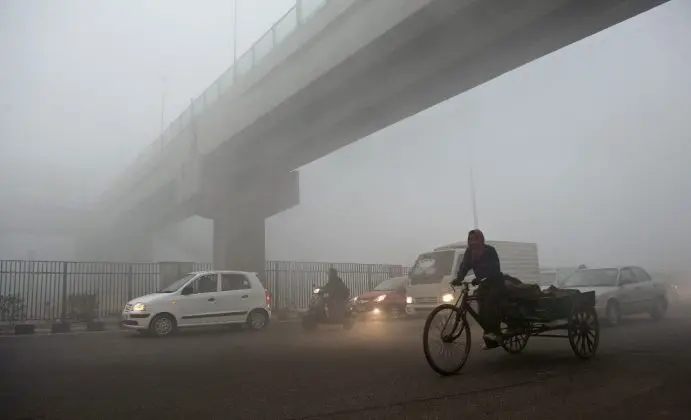
Bhubaneswar: After Angul and Balasore, the Bhubaneswar Municipal Corporation (BMC) has announced strict measures against hotels and dhaba using charcoal or wood-fired chullahs to tackle deteriorating air quality in the Odisha capital.
The decision was taken as these forms of fire are significant sources of fine particulate matter contributing to pollution in the city, where the Air Quality Index (AQI) has been hovering in the “poor” to “severe” categories during peak winter.
While pollution levels in the city reached severe earlier in the week, the AQI was recorded at around 256 (poor) by the Central Pollution Control Board (CPCB), with PM2.5 as the prominent pollutant, on January 5. Traditional chullahs used for cooking and roasting rotis in hotels, roadside dhabas, banquet halls (kalyan mandaps), and picnic spots have been identified as key emitters of PM2.5, tiny particles that penetrate deep into the lungs and cause respiratory issues.
“…strict action would be taken for the closure of hotels, dhabas, kalyan mandaps and picnic spots using charcoal or wood as fuel for the chullahs, except for religious institutions, where such practices are part of tradition. The sealing of such cooking areas of the establishments will be carried out with immediate effect,” said the BMC advisory.
Burning of garbage, dry leaves, cardboard, or any other waste in the open has also been strictly prohibited. Any violation of the same will attract a fine of Rs 5,000.
It further stated Capital Region Urban Transport (CRUT), which handles Ama Bus, have been directed to deploy water sprinklers regularly at depots to suppress dust from vehicle movements. Block education officers have been directed to use clean fuel for preparing midday meals. There is a prohibition on use of solid fuel at all picnic spots till March. The Odisha Industrial I
nfrastructure Development Corporation has also been instructed to improve the condition of roads under its control and take steps to reduce generation of dust.
Mist cannons will be installed at key locations, including Lingaraj Temple, Jayadev Vihar, and AG Square, to suppress dust particles. “Considering the increased AQI in and around Lingraj temple, the BMC Commissioner has instructed that water sprinkling through one vehicle-mounted fogging machine shall be carried out for 3-4 hours daily covering the entire area, with special emphasis near the Market Complex and Bus Stand, to reduce AQI levels.”
The corporation has also decided to enforce construction and demolition waste management rules to curb dust from transport and dumping. Besides suspending construction activities from 6 pm to 10 am, green cover is mandatory at all such sites.
The BMC has directed for strict enforcement of pollution control norms for Ready Mix Plants. These units must comply with State Pollution Control Board guidelines, including regular water sprinkling and washing of vehicles to prevent dust pollution.
Similar curbs in neighbouring Cuttack
A Standard Operating Procedures (SOPs) have been issued for Cuttack as well with district collector directed to ensure strict implementation. “To control pollution in the twin cities, we have decided to ban all ongoing civil construction work from 6 pm to 10 am. An SOP has been prepared and communicated to the concerned district collectors to ensure effective enforcement,” said Forest, Environment and Climate Minister Ganesh Singh Khuntia.
The minister also warned of strict action against the violators.
On Monday, the Balasore administration imposed restrictions on construction activities while completely banning demolition and earthwork in the municipal and NAC limits by invoking Graded Response Action Plan (GRAP) stage-II guidelines. This order will remain in force for seven days.
Earlier, the Angul administration had imposed similar restrictions for seven days as Talcher recorded extreme AQI levels ranging from 332 to nearly 400 over the past week.