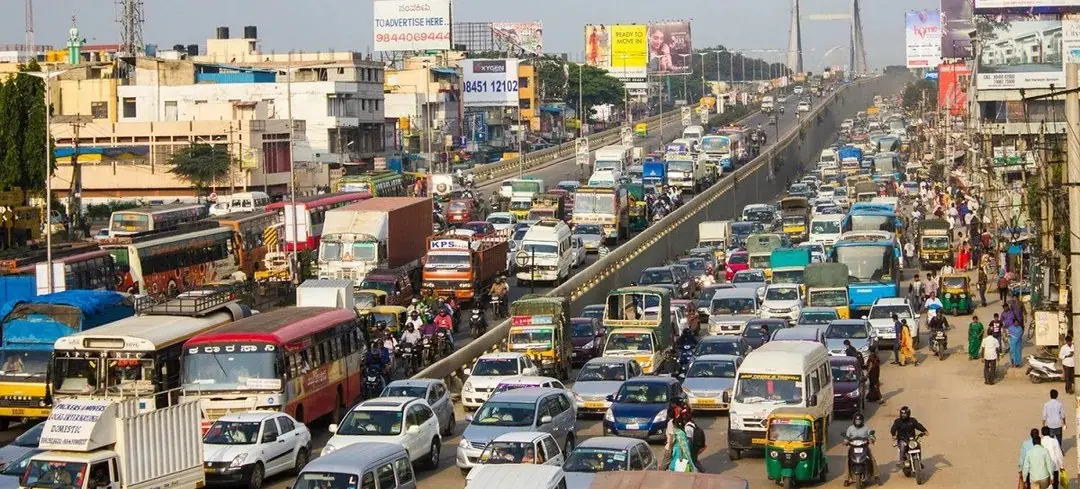
In 2024, Odisha saw a change in state administration, yet the persistent problems plaguing the capital city —waterlogging, traffic congestion, garbage management, livelihoods, and environmental degradation — remain largely unaddressed.
Like its predecessor, the current dispensation continues to focus on expanding road networks, building flyovers, and constructing ring roads. The vision appears to be that these infrastructure projects will safeguard Bhubaneswar while connecting it through its “two wings”: one stretching toward the coastal Pilgrim Town of Puri and the other toward Cuttack, the state’s cultural capital.
However, the decision-makers seem reluctant to acknowledge a fundamental reality: Bhubaneswar was originally designed with a grid-iron pattern that prioritised comfort for children, women, cyclists, pedestrians, and public transport users, rather than accommodating highways, flyovers, and ring roads. There is a well-established law of congestion in urban planning: no matter how many roads are built or widened, congestion eventually returns.
In the last decades, cities across the globe underwent massive experiments with some expanding major roads, only to see congestion reappear often within about five years, and a few went investing in slow streets, pedestrian-friendly designs, and public transit with far better long-term results.
In simple terms, widening of roads tends to increase traffic on a particular stretch rather than reduce congestion. Reduced travel time makes driving “cheaper”, so people drive more often and farther. As more vehicles fill the roads, congestion returns to its previous level—the system’s natural equilibrium. Congestion always wins.
A key question for Bhubaneswar is: Where does this new traffic actually come from? Research shows that newly generated trips typically arise from – existing residents driving more (9–39%), increased heavy vehicle movement (19–29%), new migration and population growth (5–21%), drivers switching from side roads to the newly widened corridor (0–10%).
On the surface, this appears to be a positive outcome, more trips and more driving should translate into increased social and economic activity that might not have occurred otherwise. Yet the social and economic benefits generated by this new traffic are rarely defended in detail or even properly modelled to determine whether they justify the project’s financial costs (construction and ongoing maintenance) as well as its social downsides (increased pollution and traffic fatalities).
Highway expansions are routinely marketed as “congestion-busting” solutions. Acknowledging the reality of induced demand would mean admitting that congestion would eventually return, which would undermine the entire justification for these projects. As a result, planners and engineers tend to remain silent about the actual effects of road widening and instead cling to the idea that congestion can be permanently defeated.
In practice, widening selected roads often merely sh
ifts bottlenecks elsewhere. While one corridor may flow freely for a time, new choke points emerge in adjacent areas. If widening genuinely makes driving faster and more attractive, it can trigger even more driving — setting off a self-reinforcing cycle of congestion and repeated widening. Fixing one bottleneck often creates three more, fixing those creates nine more.
Overall, the total amount of congestion in the system either stays roughly constant or grows with more people getting exposed to its negative effects.
Despite seven decades of global evidence showing the limited long-term effectiveness of road widening, governments in Bhubaneswar continue down the same path. The issue goes beyond engineering, understanding the politics behind road widening is essential. Interestingly, elected and professional officials at state, regional, and local levels hold sharply divided views on urban planning. Some are convinced that widening reduces congestion, others argue the short-term relief justifies the expense, while a third group believes combining road expansion with bicycle lanes and better public transit can deliver real, lasting benefits.
In Bhubaneswar’s urban planning debates, the conversation is slowly shifting. The question is moving from “if” to “how much?” This has sparked intense disagreement over forecasting techniques and the proper application of empirical evidence to individual projects, especially since successive flyovers, road widening, and highway expansions in Bhubaneswar have so far failed to deliver meaningful congestion relief.
The proposed infrastructure linking Bhubaneswar–Puri–Cuttack will undoubtedly drive a real-estate boom once the metro rail arrives. This makes it the right moment for serious urban planning intervention in the tri-city region, prioritise first- and last-mile connectivity to the metro, build mobility underpasses to link both sides of the East Coast Railway, and invest in a comprehensive network of cycling paths, pedestrian walkways, and possibly canal-based connectivity and and green corridors.
These measures would deliver far greater long-term value than continuing with the present automobile-centric approach.
No city in the world has ever solved its mobility crisis simply by building more flyovers or elevated corridors. Successful cities have instead invested in mass rapid transit, parallel road networks, and robust non-motorised infrastructure for walking and cycling. At many places, elevated roads have been repurposed into weekly markets, jogging tracks, public plazas, and community spaces precisely because they failed to attract sustained vehicular traffic.
The same fate awaits Bhubaneswar’s elevated corridors once competing parallel roads open.
If flyovers and wider roads truly solved traffic problems, every major junction in Bhubaneswar would eventually require one. Instead, these projects often worsen waterlogging, increase congestion in the long run, and create new public health problems. Building bigger roads to fix traffic is like buying larger clothes to hide obesity instead of addressing the root cause, over-dependence on private vehicles.
A Viksit Odisha without thoughtful urbanisation is unrealistic. True progress demands innovation in urban services, especially mobility. Bhubaneswar deserves planning that learns from global evidence rather than repeating the same expensive and ultimately self-defeating mistakes.