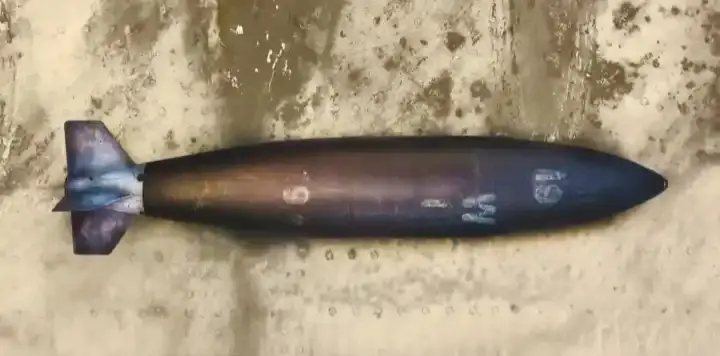
Jamshedpur: Even as the Middle East conflict continues, the chance discovery of an unexplored World War II bomb on the bank of the Subarnarekha River at Bahragora in Jharkhand has brought back memories of a forgotten airfield and its use by the Americans in the China-Burma-India theatre.
On Monday, Army engineers from Ranchi inspected the site where the bomb is lying, about 90 km from Jamshedpur. They were accompanied by members of the bomb disposal squad of the Jharkhand Police.
“The officials examined the area before they initiate measures to defuse the bomb. The team also conducted mapping of the spot with the help of drones, Ajit Kumar Kujur, SDPO, Ghatsila, said.
Rishav Garg, SP (Rural), East Singhbhum, was quoted as saying by The Tribune that the bomb detection and disposal squad (BDDS) had inspected the site and found the device to be ‘active’ and heavy.
“The BDDS team is
trained to handle IEDs and small explosives. However, they assessed that the old bomb is still active and requires the expertise of the Indian Army for safe disposal,” he said.
The BDDS unit apparently informed the police that the “powerful bomb cannot be disposed of using standard procedures” and requires advanced technical expertise available with the Army.
The police said that the 500-pound bomb, resembling a gas cylinder, was unearthed during sand excavation along the Panipada-Nagudsai stretch. The markings on it include ‘AN-M64 500 unexploded’.
Those wondering how the bomb could have reached Bahragora of all places, need to be reminded of the Chakulia airfield that was home to the 40th Bombardment Group of the US Army Air Force (USAF) during World War II.
The USAF had stationed B-29 Superfortress aircraft there. The base was used for attacks on Japanese-held areas and Japanese home islands since 1944.
Chakulia, about 80 km from Jamshedpur, but in another direction, is less than 40 km from Bahragora.
Military historians believe that the B-29s may have used the banks of the Subarnarekha – that were far less populated at that time – to practice their bombing runs. Some of the ordnance may have remained unexplored, posing a threat to innocents nearly 82 years later.