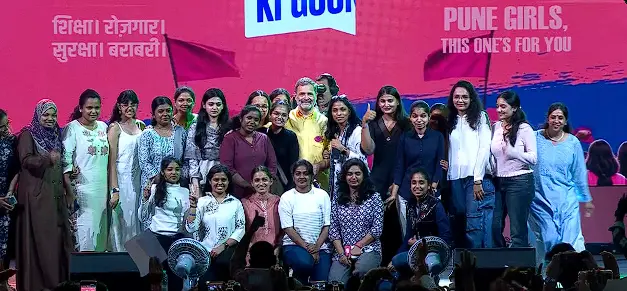
Pune: Congress leader and Leader of Opposition in the Lok Sabha Rahul Gandhi on Saturday said women should not be viewed only through their traditional family roles, arguing that they must be recognised as individuals with the right to shape their own lives.
He made the remarks during an interaction with girl students and professional women in Pune at the Congress’ “Chhatron Ki Goonj” programme. Gandhi said women represented the country’s greatest strength but were systematically held back by social attitudes that discouraged independence and personal choice.
At the beginning of the programme, Gandhi said he would avoid politics and would not make a standard speech. Instead, he said, he wanted women to speak about their experiences, concerns and aspirations, as reported by The New Indian Express.
“The women of India are India’s biggest strength. There are 70 crore women in India, and they are the strength of India. India’s young, bold and strong women are the strength of India, but they are always seen as daughters, sisters, wives and mothers, and framed in that framework,” Gandhi said.
He said there was no issue with women performing these roles, but cautioned against allowing such identities to define their entire lives.
“We should not have a problem with playing these roles, but women are beyond that also. They are bigger than that. No one should restrict their growth,” he said.
‘Her First Identity Is Her Own’
Gandhi said women should be free to decide where they wanted to study, work and live, describing the need to “break the cage” as the main idea behind the interaction.
“The woman belongs to herself first, and that is her first identity; then other roles like sister, daughter, wife and mother play,” he said.
Gandhi Criticises Manusmriti & RSS
He then turned his criticism towards the Manusmriti and the RSS, claiming that the social system associated with the text worked against women’s freedom and advancement.
“The Manusmriti — the draconian book of the RSS — is against the independence and progress of women. We have to oppose that concept and break the cage,” he said.
Gandhi said women were not required to establish their worth before men. He alleged that social control over women was maintained through violence, humiliation and restrictive customs.
“The women are controlled through violence and disrespect,” he said, adding that violence and physical harassment imposed a significant cost on women.
Claims On Violence & Inequality
To illustrate the difficulties faced by women, the Congress leader cited several statistics during the programme. He claimed that approximately 4.5 lakh female foetuses were aborted each year, while 80 per cent of women faced harassment in some form. He further claimed that 29 per cent experienced physical violence and six per cent were victims of rape.
Gandhi also spoke about the unequal access women have to education and employment. He said safety concerns and the fear of harassment prevented many women from joining or continuing work.
“Fifty per cent of women are not given the work opportunity or are forced to reject the work due to safety and to avoid harassment. Besides, they are also deprived of education and financial independence. They spend double on travelling for safety,” he said.
He referred to restrictions on women’s movement and said a large number of girls and women were still expected to travel only with male relatives or acquaintances.
“Sixty per cent of women cannot leave the house alone. If the woman or the girl wants to go out, she has to go out with a male such as a father, brother, husband or male friend. But the girl hardly goes out alone,” Gandhi said.
He also claimed that women were frequently denied the authority to make personal decisions. According to him, marriage and domestic responsibilities were among the reasons many girls discontinued their education.
“There is a 45 per cent drop in girls’ education due to marriages and household work,” he said.
Gandhi further highlighted the limited ownership of assets among women, claiming that only eight per cent owned property in their own names.
The participants at the event, including students and working women, raised issues related to academic opportunities, choice of courses, jobs, workplace conduct and financial security.
The discussion centred on the difficulties women faced in obtaining education, entering employment, gaining economic independence and exercising greater control over their personal and professional decisions.