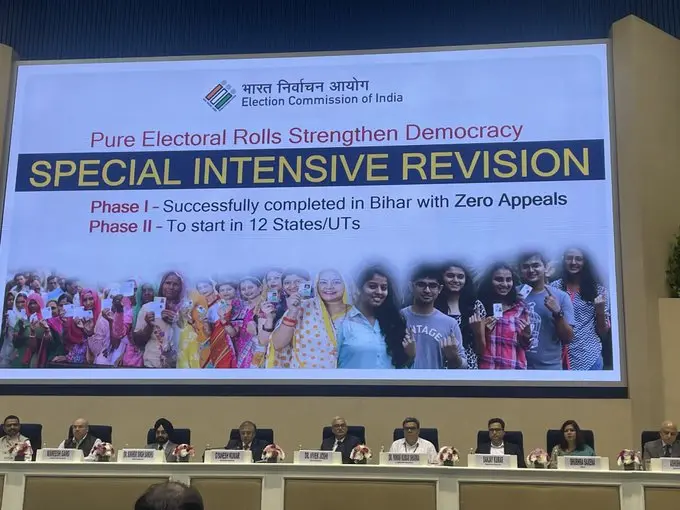
New Delhi: The Election Commission of India announced on Monday that the second phase of the Special Intensive Revision (SIR) of electoral rolls will be conducted in 12 states, following the completion of the exercise in Bihar. The move marks a major nationwide push to update and clean the voter list, with the poll-body emphasising that it will begin from November 1 and prioritise states such as Tamil Nadu, West Bengal, Kerala and Assam.
Voter list of 12 states and UTs that will go under SIR exercise will freeze tonight (October 27).
#WATCH | Delhi: Chief Election Commissioner Gyanesh Kumar says, “…The second phase of SIR (Special Intensive Revision) is about to be carried out in 12 States/UTs.” pic.twitter.com/bKE65UFDay
— ANI (@ANI) October 27, 2025
In a press conference held at around 4:20 pm on Monday, Gyanesh Kumar, the Chief Election Commissioner, announced that the SIR exercise would now be extended beyond Bihar to a broader set of states – Andaman & Nicobar, Chhattisgarh, Goa, Gujarat, Kerala, Lakshadweep, Madhya Pradesh, Puducherry, Rajasthan, Tamil Nadu, UP and West Bengal.

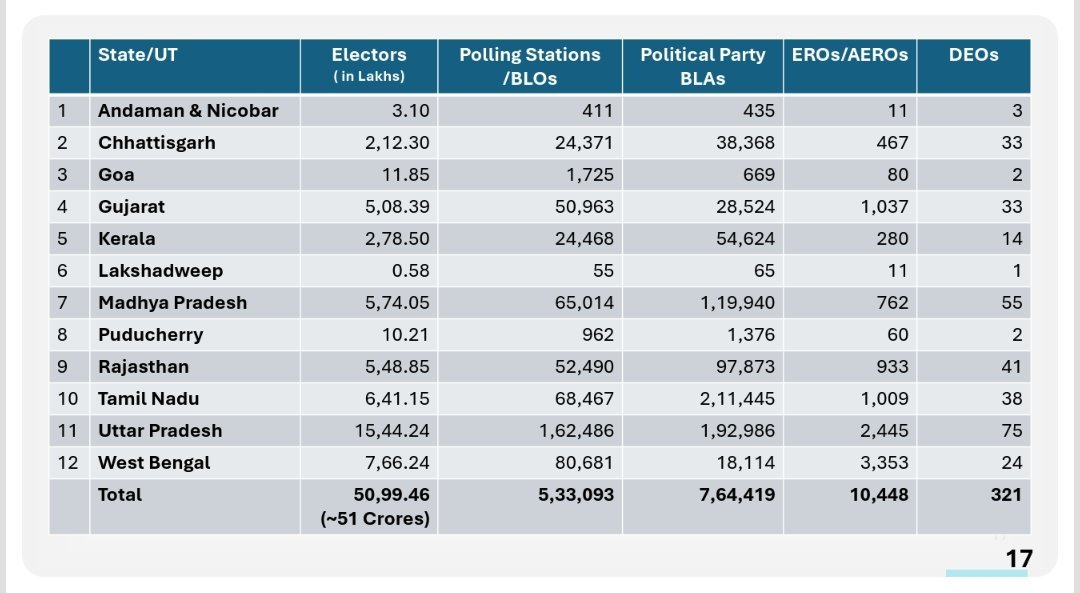
Takeaways from the EC presser:
* Each polling station has one Booth Level Officer (BLO)
* Each Assembly Constituency has several Polling Stations
* Each Assembly Constituency has One Electoral Registration Officer (ERO)
* The ERO is a Sub Divisional Magistrate (SDM) level Officer who, as per Law:
* The ERO Prepares the Draft Electoral Rolls, receives and decides on claims and objections, and prepares and publishes the final electoral rolls.
* Assistant Electoral Registration Officers) (AEROs) in each Tehsil
* The District Magistrate hears the 1st appeal against the decision of ERO
* The CEO of the State/UT hears the 2nd Appeal against the decision of DM
What SIR means
* SIR is a deep-revision of the electoral rolls, going beyond the usual summary revision, aimed at including all eligible citizens and removing ineligible entries such as deceased persons, duplicates or non-residents.
* For example, in Bihar the qualifying date was set, electors registered after January 2003 were required to submit additional documents, while those registered earlier did not.
* The Commission’s June notification underlines the legal basis (Articles 324 & 326 of the Constitution; Section 21 of the Representation of the People Act) for such a special revision.
Why now and why these states
* In Bihar, the first phase of SIR concluded with a marked drop in the number of electors—7.42 crore in the final roll compared with 7.89 crore earlier.
* The Commission said that rapid urbanisation, migration and frequent changes in residence have made the electoral rolls increasingly unreliable. SIR is intended to offset these structural issues.
* The states identified for the second phase—Tamil Nadu, West Bengal, Kerala, Assam and Union Territory Puducherry—are scheduled for assembly polls next year; thus they were singled out for priority.
Controversies and concerns
* Opposition parties have raised objections to SIR, claiming the process may lead to disenfranchisement of vulnerable groups.
* The Supreme Court of India has intervened on aspects of the process — for example, it directed the Commission to accept Aadhaar as a valid identity proof for inclusion in the revised rolls in Bihar.
What happens next
* The enumeration phase, where electors submit forms and update details, is expected to start November 1 in the identified states. A draft roll will then be published, followed by claims/objections, and a final roll by late January or early February.
* Politically, the exercise demands active involvement of parties, booth-level agents and electors alike; the Commission emphasised minimal inconvenience to citizens despite the scale of the effort.