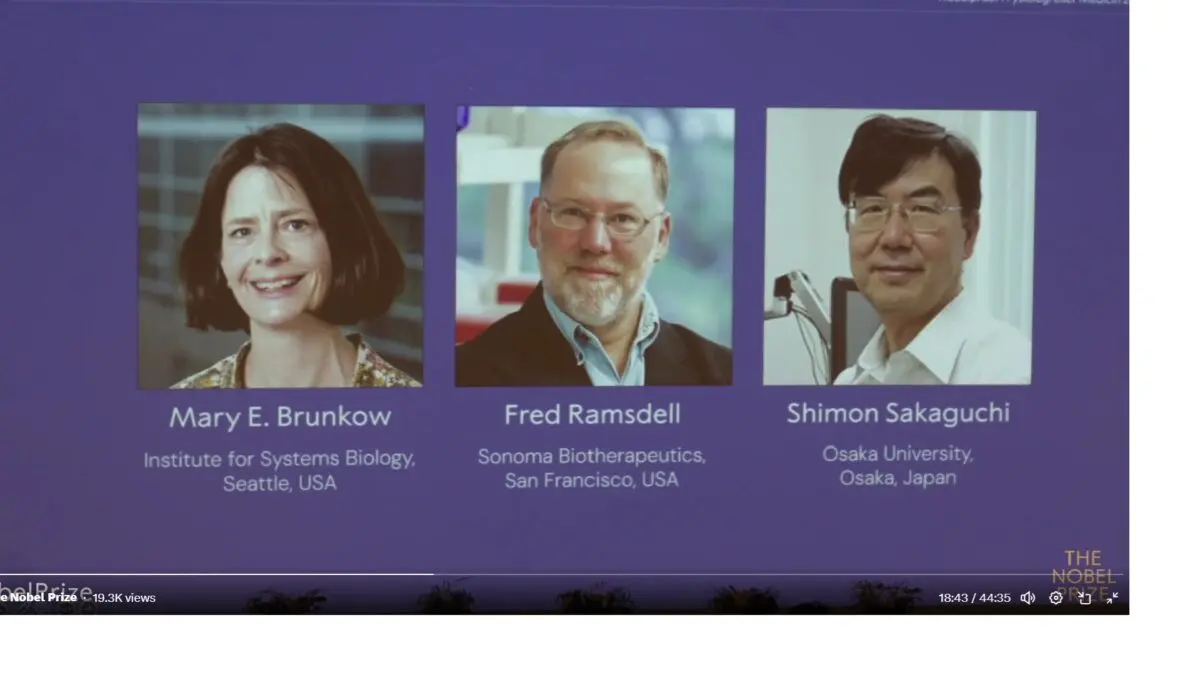
Stockholm: The 2025 Nobel Prize in Physiology or Medicine has been awarded jointly to Mary E. Brunkow, Fred Ramsdell, and Shimon Sakaguchi for their groundbreaking discovery of peripheral immune tolerance, a mechanism that prevents the immune system from attacking the body’s own cells, the Nobel Assembly at Sweden’s Karolinska Institutet announced on Monday.
The trio’s work revealed how a specific group of immune cells, called regulatory T cells (Tregs), keep the immune system in check and prevent autoimmune diseases. Their discovery has transformed the understanding of how immune tolerance operates beyond the thymus and paved the way for new therapies in autoimmune disorders, cancer, and organ transplantation.
Brunkow and Ramsdell, while studying a fatal autoimmune condition in mice known as “scurfy,” identified mutations in the FOXP3 gene, showing its vital role in immune regulation. Sakaguchi, working independently in Japan, first discovered regulatory T cells in 1995 and later demonstrated that FOXP3 is the key factor controlling their development and function.
“The discoveries by Brunkow, Ramsdell and Sakaguchi have revolutionized our understanding of immune self-control and opened new therapeutic possibilities,” the Nobel Committee said.
The three laureates will share the prize money of 11 million Swedish kronor (approximately USD 1.2 million). The Nobel Prize awards ceremony will be held in Stockholm on December 10, the anniversary of Alfred Nobel’s death.
Their research continues to influence the development of treatments for diseases such as type 1 diabetes, rheumatoid arthritis, and multiple sclerosis, while also improving strategies in cancer immunotherapy and transplant medicine, where fine-tuning immune tolerance is crucial.