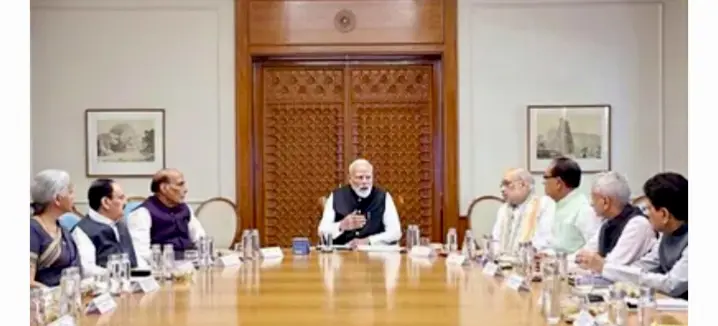
New Delhi: The Union Cabinet on Friday approved amendments to the proposed Constitutional Amendment Bill linked to delimitation and women’s reservation.
The revised framework providing for a 50 per cent increase in the number of Lok Sabha seats while keeping the allocation of seats among states frozen for 25 years, sources told News18.
The freeze on the inter-state distribution of seats will continue until 2051, the amendment says. The legislation required a special majority of two-thirds of members present and voting and failed to cross the threshold.
The Bill sought to amend the constitutional framework to facilitate an expansion of the Lok Sabha and advance the implementation of the 33 per cent quota for women in Parliament and state assemblies.
The government had also introduced a Delimitation Bill and a separate Bill relating to Union Territory laws as part of the legislative package. The linked proposals were not taken up after the Constitution Amendment Bill failed.
The 33 per cent women’s reservation was provided for under the Constitution (106th Amendment) Act, 2023, but its implementation was linked to a future Census and delimitation exercise. The Centre’s proposed changes seek to bring forward its rollout, potentially in time for the 2029 Lok Sabha elections.
The revised proposal will now have to be introduced and secure the constitutionally mandated special majority in Parliament.
Cabinet approval does not by itself change the existing constitutional provisions. addressing concerns that a population-based delimitation exercise could alter the political balance between states.
The 50 per cent increase in seats is expected to apply uniformly across states, allowing every state to gain representation while broadly retaining its existing share in the Lok Sabha.
The proposal is aimed at addressing objections, particularly from southern states, which have argued that a delimitation exercise based on population could reduce their relative political representation because of lower population growth.
The Cabinet’s approval comes ahead of the special sitting of Parliament scheduled to begin on November 30. The Lok Sabha is expected to meet on November 30 and December 1, while the Rajya Sabha will sit on December 2 and 3.
The government has indicated that it intends to bring significant legislative business during the sitting, though Parliamentary Affairs Minister Kiren Rijiju has not publicly specified the Bills to be introduced.
The proposed changes seek to revive the Centre’s effort to link delimitation with the implementation of 33 per cent reservation for women in the Lok Sabha and state legislative assemblies.
The existing strength of the Lok Sabha is 543. A 50 per cent increase would take its strength to around 816 seats. The expansion is intended to create additional seats while ensuring that states do not lose their relative share in the House.
The issue of delimitation has been politically contentious because southern states, which have made greater progress in controlling population growth, fear that allocating seats purely on the basis of population could tilt representation in favour of states with higher population growth.
The proposed 25-year freeze on the inter-state allocation of seats is significant in this context. It would mean that while the number of seats may increase, the relative share of states would remain protected until 2051.
The government had earlier assured Parliament that the proposed 50 per cent increase would benefit all states and would not reduce the representation of southern states. However, Opposition parties had argued that these assurances needed to be incorporated into the actual legislation.
The Cabinet’s decision comes seven months after the government’s earlier attempt to push through the delimitation-linked women’s reservation package failed in the Lok Sabha.
The Constitution (131st Amendment) Bill, 2026, was defeated on April 17 after securing 298 votes in favour and 230 against. The legislation required a special majority of two-thirds of members present and voting and failed to cross the threshold.
The Bill sought to amend the constitutional framework to facilitate an expansion of the Lok Sabha and advance the implementation of the 33 per cent quota for women in Parliament and state assemblies.
The government had also introduced a Delimitation Bill and a separate Bill relating to Union Territory laws as part of the legislative package. The linked proposals were not taken up after the Constitution Amendment Bill failed.
The 33 per cent women’s reservation was provided for under the Constitution (106th Amendment) Act, 2023, but its implementation was linked to a future Census and delimitation exercise. The Centre’s proposed changes seek to bring forward its rollout, potentially in time for the 2029 Lok Sabha elections.
The revised proposal will now have to be introduced and secure the constitutionally mandated special majority in Parliament. Cabinet approval does not by itself change the existing constitutional provisions.