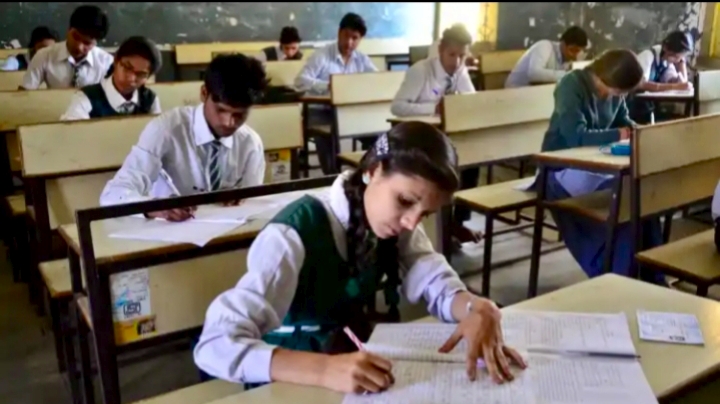
New Delhi: The Central Board of Secondary Education (CBSE) has officially approved the introduction of Open-Book Assessments (OBAs) for Class-IX students, starting from the 2026-27 academic session.
Unlike traditional exams, OBAs allow students to consult textbooks and other approved resources during the test. The format is designed to evaluate conceptual understanding, analytical thinking, and the ability to apply knowledge in different contexts, marking a shift away from rote-focused learning.
According to India Today, the decision was ratified by the Board’s governing body on June 25, and is in line with the National Curriculum Framework for School Education (NCFSE) 2023 and National Education Policy (NEP) 2020. It aims to promote competency-based learning and reduce dependence on rote memorisation.
Under this system, OBAs will be integrated into the three pen-paper assessments conducted each term, covering core subjects such as Language, Mathematics, Science, and Social Science. “The initiative seeks to foster critical thinking, encourage real-world application of concepts, and alleviate exam-related stress amongst students,” an official said.
The idea was first reviewed by the CBSE curriculum committee in November 2023 and received approval later that year. To assess its feasibility, the Board conducted a pilot project in select schools. For Classes 9 and 10, the tests were trialled in English, Mathematics, and Science, while Classes 11 and 12 attempted them in English, Mathematics, and Biology. The pilot project aimed to measure student performance, time management, and stakeholder feedback.
Findings from the study revealed that students scored between 12% and 47%, with many facing challenges in effectively using reference materials and understanding interdisciplinary concepts. However, teachers remained optimistic about the system’s potential to enhance higher-order thinking skills.
To support smooth implementation, CBSE will provide a detailed framework, structured guidance, and standardised sample papers for open-book testing. Initially, the assessments may not be mandatory for all schools, allowing them flexibility in adoption.
This is not the first time CBSE has experimented with such an approach. Between 2014-15 and 2016-17, it introduced the Open Text-Based Assessment (OTBA) for Classes 9 and 11. This was later discontinued after mixed responses from students and educators.