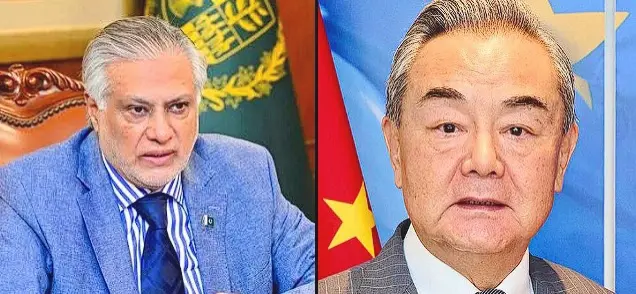
Beijing/Islamabad: China and Pakistan jointly proposed a five-point roadmap on Tuesday to halt the West Asia crisis, prioritizing Gulf stability and secure shipping through the Strait of Hormuz.
The initiative followed talks between Chinese Foreign Minister Wang Yi and Pakistan’s Deputy Prime Minister and Foreign Minister Ishaq Dar, who visited Beijing for a day to address regional tensions, PTI reported.
The duo assessed the Gulf and West Asia situation, with Dar updating Wang on his recent engagements with counterparts from Turkiye, Egypt, and Saudi Arabia aimed at fostering US-Iran dialogue to resolve the conflict.
Post-meeting, the nations issued proposals targeting peace in the Gulf and West Asia alongside unimpeded Strait transit. Key elements: instant halt to fighting, swift peace negotiations, safeguards for civilian sites and maritime routes, and UN Charter supremacy.
“China and Pakistan call for immediate cessation of hostilities and utmost efforts to prevent the conflict from spreading. Humanitarian assistance must be allowed to all war-affected areas,” according to a joint statement.
They also pressed for “starting peace talks as soon as possible.”
“Sovereignty, territorial integrity,
national independence and security of Iran and the Gulf states should be safeguarded. Dialogue and diplomacy is the only viable option to resolve conflicts,” the statement said.
The joint statement underscored civilian protections, calling on parties “to immediately stop attacks on civilians and nonmilitary targets, and fully adhere to International Humanitarian Law (IHL), and stop attacking important infrastructure, including energy, desalination and power facilities, and peaceful nuclear infrastructure, such as nuclear power plants.”
It also urged parties “to protect the security of ships and crew members stranded in the Strait of Hormuz, allow the early and safe passage of civilian and commercial ships, and restore normal passage through the Strait as soon as possible.”
The plan culminated in upholding UN Charter primacy to de-escalate tensions.
Prior to Beijing, Dar hosted a quadrilateral huddle in Islamabad with Saudi Arabia, Turkiye, and Egypt’s foreign ministers. His China ties included prior calls with Wang and sessions with Beijing’s envoy in Pakistan.
China’s Foreign Ministry spokesperson Mao Ning noted three of its oil-laden vessels had navigated the strait post-coordination with relevant parties, expressing gratitude—implicitly to Iran, which manages Gulf outflows and asserts sovereignty claims.
As a top Iranian oil buyer defying US sanctions, China has demanded military halts since US-Israel strikes on Tehran and advocated open Hormuz access amid supply chaos. Beijing condemned the assaults while gearing up for President Donald Trump’s May 14-15 visit, eyeing a bilateral trade pact.