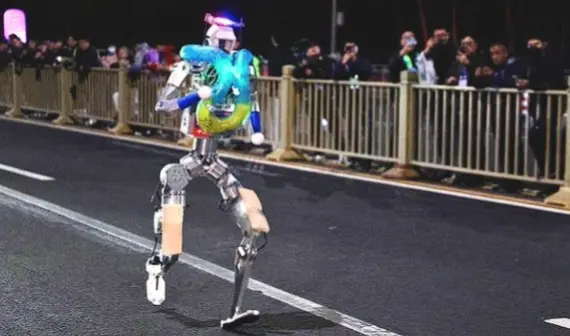
Beijing: Scores of homegrown Chinese humanoid robots flexed their enhanced speed and self-guided movement in Sunday’s Beijing half-marathon, overtaking human competitors and spotlighting explosive progress in the field, Reuters reported.
The event’s debut last year was marred by glitches, leaving most entrants sidelined. The top robot then took 2 hours and 40 minutes — over twice the pace of the human victor in the standard race.
This year, however, the contrast was striking. The number of participating teams jumped from 20 to more than 100, and several leading robots finished well ahead of the human winners, beating them by more than 10 minutes.
Unlike the previous edition, when most robots relied on remote control, nearly half of this year’s entrants navigated the tougher stretches of the course autonomously. They raced alongside 12,000 human athletes on separate paths to avoid collisions, keeping the event orderly despite the mix of metal and muscle.
The winning robot, developed by Chinese smartphone brand Honor — a spin‑off from Huawei — crossed the finish line in 50 minutes and 26 seconds, several minutes faster than the half‑marathon world record recently set by Uganda’s Jacob Kiplimo in Lisbon. All three podium spots were taken by Honor’s self‑navigated robots, each posting times that surpassed the human benchmark.
Du Xiaodi, an engineer on Honor’s winning team, said the robot had been under development for about a year. “Its legs are 90 to 95 cm long, designed to mimic the stride and posture of elite human runners,” he explained, adding that the robot also used liquid cooling technology drawn from Honor’s smartphones. Du stressed that the humanoid sector remains in an early, experimental phase, but he expressed confidence that these machines will eventually reshape many industries, including manufacturing.
Leap in Robot Capabilities
Onlookers hailed the showcase of varied humanoid forms and strides as a testament to China’s robotics gains.
“The humanoid robots’ running posture I saw was really quite impressive… considering that AI has only been developing for a short time, I’m already very impressed that it can achieve this level of performance,” said Chu Tianqi, a 23-year-old engineering student at Beijing University of Posts and Telecommunications.
“The future will definitely be an AI era. If people don’t know how to use AI now, especially if some are still resistant to it, they will definitely become obsolete,” he said.
Eleven‑year‑old schoolboy Guo Yukun, watching the race alongside his classmates, said the event had inspired him to pursue a university degree in robotics. “I take regular classes in robotics theory and programming at my elite Beijing school, and I’m part of my school’s team for the International Olympiad in Informatics, a global programming competition for high schoolers,” he said.
Path to Practical Robot Uses
Humanoid robots’ real‑world economic applications are still largely confined to testing grounds and pilot projects, but the Beijing half‑marathon vividly underscored their growing physical capabilities for high‑risk and physically demanding roles. The machines’ ability to maintain speed, balance, and coordination over 21 km suggests they could one day be deployed in hazardous environments such as disaster‑response zones, nuclear facilities, or conflict‑affected areas where human presence is dangerous or logistically difficult.
That said, Chinese developers continue to trail in the artificial‑intelligence and perception systems needed to match the subtle finesse and adaptability of human workers on factory floors. While the robots can run, navigate, and even synchronize movements in choreographed displays, replicating the nuanced touch, improvised problem‑solving, and multitasking of a human operator remains a distant goal.
China’s Push for Robotics Leadership
China is working hard to become a global leader in humanoid robotics, supporting the industry with subsidies, research funding, and infrastructure projects that help local companies grow. The government and businesses see humanoid robots as a key part of the future of manufacturing and automation, essential for staying competitive worldwide.
This goal was clearly on display in February at the annual CCTV Spring Festival gala, where more than a dozen Unitree humanoid robots performed an elaborate act. Wearing traditional martial arts outfits, they carried out synchronized routines with swords, poles, and nunchucks, moving closely around groups of child performers. The performance was widely seen as a symbolic show of China’s ambition to lead in the next generation of robotics and industrial technology.