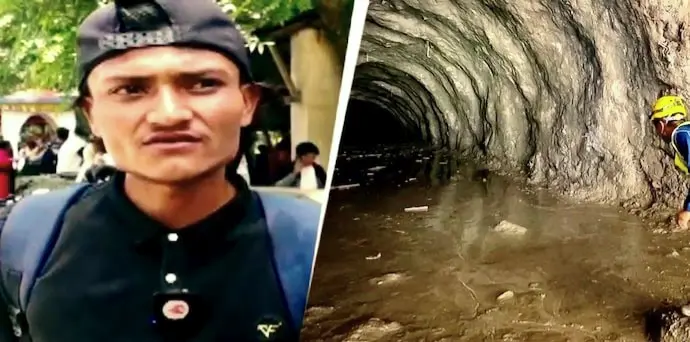
Kathmandu: In a shocking claim, a worker who survived Nepal’s flash flood, has accused a Chinese supervisor of fleeing a fleeing a mud-filled tunnel at the Trishuli-3A Hydropower Station after workers sought his help to escape, leaving hundreds trapped inside.
The project is being built by Power China Corporation, and Chinese personnel supervise the engineering work.
At least 40 people remain unaccounted for at Trishuli-3A, while over 900 workers are missing from hydropower projects affected by the flood. Rescue teams are racing against time to reach workers trapped inside tunnels blocked by mud and debris.
Raj Chhetri, who survived the disaster, said he and other workers were inside Tunnel No. 3 when flash floods occurred. He alleged that he sought permission from a Chinese supervisor to leave after hearing a loud noise and sensed danger, but the supervisor told him he would “go and see” before leaving the tunnel himself, as reported by India Today.
“I asked the Chinese supervisor to let us out. He said, ‘I’ll go and see,’ and then he fled,” Chhetri alleged.
Damaged infrastructure, poor weather and the difficulty of accessing underground facilities has complicated rescue operations. At Trishuli-3A, teams are using heavy equipment and specialised techniques to reach tunnels buried under mud and debris.
A powerful surge of water, mud and debris entered the tunnel and swept away workers, vehicles and their belongings, Chhetri said. He also said he ran towards the mouth of the tunnel and managed to escape. “Four of us fled. Two are still missing,” he said.
Around 265 people were working in Tunnel No. 3 when the floods struck, Chhetri claimed. Bodies were lying inside the tunnel and survivors could be heard crying for help, he said.
“The bodies of many hydropower workers are lying in the tunnel above. Many are still alive. We could hear cries of ‘Save, save’,” Chhetri said. He described the ordeal as a desperate choice between trying to save others and saving his own life.
Chhetri said that after escaping the floods, he and other survivors spent the first few days in the forest, sleeping under a tree. They had no mobile phones and even if they had, the mobile network was down in the area, he alleged.
The lack of communication meant workers could not tell their families that they had survived, he said, saying that he was able to contact his family only after mobile connectivity was restored.
“What the Chinese government did was wrong. They knew about the flood and landslide,” Chhetri alleged.
“If we had received information beforehand, many lives and property could have been saved,” he said, suggesting that an advance warning could have allowed workers to evacuate.
Families of workers trapped in flooded hydropower tunnels have been questioning the pace of rescue operations, with relatives saying days have passed with little visible progress.
The wife of an engineer trapped at Trishuli-3A recently said that six days have passed with little sign of a meaningful rescue effort. Families had been moving between government offices and the Army headquarters seeking information, she said.
The flash flood struck on August 26, after a glacier collapse triggered massive torrents of water, mud and debris along the Nepal-Tibet border. The disaster caused heavy damage to settlements, roads, bridges and other key infrastructure.
Initially, Nepal refused to allow rescue workers from other countries to take part in the operations. It was only on August 29 that it allowed special teams to enter the country for search and rescue. Vital time had been wasted by then.
As of now, 1,127 people have died in Nepal, with over 4,000 still missing, according to the police. In neighbouring Tibet, Chinese authorities have reported 16 deaths and 546 people missing.