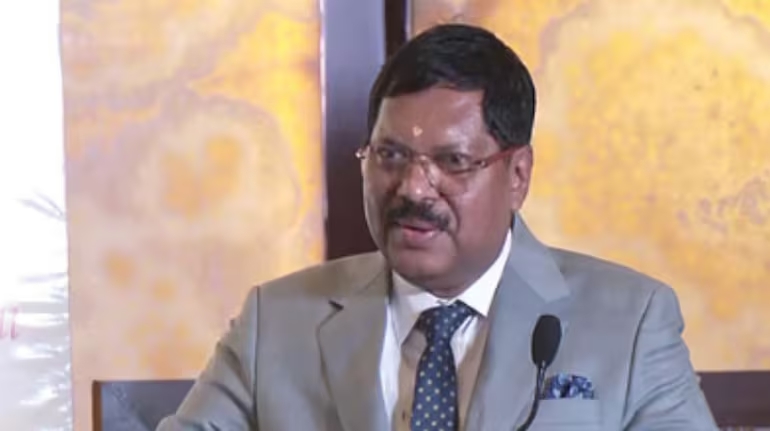
New Delhi: Chief Justice of India (CJI) BR Gavai has expressed serious concern about retired judges taking up government appointments or entering electoral politics shortly after stepping down.
Speaking at a roundtable discussion on judicial independence at the Supreme Court of the United Kingdom, Gavai said that such actions raise significant ethical issues and risk damaging public trust in the judiciary.
The CJI made the point that accepting post-retirement government roles could easily lead to a perception that judicial decisions were made with an eye on future political or governmental opportunities.
“If a judge takes up another appointment with the government immediately after retirement, or resigns from the bench to contest elections, it raises significant ethical concerns and invites public scrutiny. A judge contesting an election for a political office can lead to doubts regarding the independence and impartiality of the judiciary, as it may be seen as a conflict of interest or as an attempt to gain favour with the government,” the CJI said.
Gavai emphasised that he and many of his colleagues had “publicly pledged not to accept any post-retirement roles or positions from the government in an effort to preserve the credibility and independence of the judiciary.”
Supreme Court and high court judges have, in recent years, taken up roles offered by the executive soon after demitting office, thus amplifying the debate over the burning issue.
Here are some prominent cases of judges taking the plunge into politics or accepting government roles after stopping practice:
* Calcutta High Court judge Justice Abhijit Gangopadhyay resigned in March 2024, joined BJP two days later, contested the Lok Sabha elections and won from Tamluk constituency in West Bengal.
* Justice SA Nazeer retired as a Supreme Court judge in January 2023 and was appointed as Andhra Pradesh Governor a month and a half later. Justice Nazeer was on the then-CJI Ranjan Gogoi-headed five-judge Ram Janmabhoomi case bench which ruled that the Ayodhya land would be handed over to the Hindu party.
* Justice Gogoi was nominated to the Rajya Sabha by then-President Ram Nath Kovind, four months after retiring as CJI in November 2019.
* Before Gogoi another CJI Ranganath Misra was elected to the Rajya Sabha, and served from 1998 to 2004.
* Former Supreme Court judge Fathima Beevi was appointed Governor of Tamil Nadu (1997-2001).
* Former CJI P Sathasivam was appointed Governor of Kerala (2014-2019)
* Justice K Subba Rao contested the fourth Presidential elections
* Justice Mohammad Hidayatullah was elected India’s Vice-President (1979-1984).
* Justice Arun Mishra was appointed chairperson of the National Human Rights Commission within a year of retirement.
* Several high court judges have taken gubernatorial or tribunal posts immediately after leaving the bench.
‘Judicial corruption, misconduct’
Without naming anyone, CJI Gavai acknowledged a disturbing malaise afflicting the India judiciary — corruption and professional misconduct among judges.
“Sadly, there have been instances of corruption and misconduct that have surfaced even within the judiciary. Such occurrences inevitably have a negative impact on public confidence, potentially eroding faith in the integrity of the system as a whole,” Gavai said.
He suggested that the path to rebuilding the trust is through swift, decisive and transparent action to address and resolve these issues. “In India, when such instances have come to light, the Supreme Court has consistently taken immediate and appropriate measures to address the misconduct,” he said.
“Transparency and accountability are democratic virtues. In today’s digital era, where information flows freely and perceptions are rapidly shaped, the judiciary must rise to the challenge of being accessible, intelligible, and answerable, without compromising its independence.”
The cash-at-home controversy surrounding high court judge Yashwant Varma recently shocked India, triggering calls for clearer standards vis-à-vis judicial accountability and greater transparency.