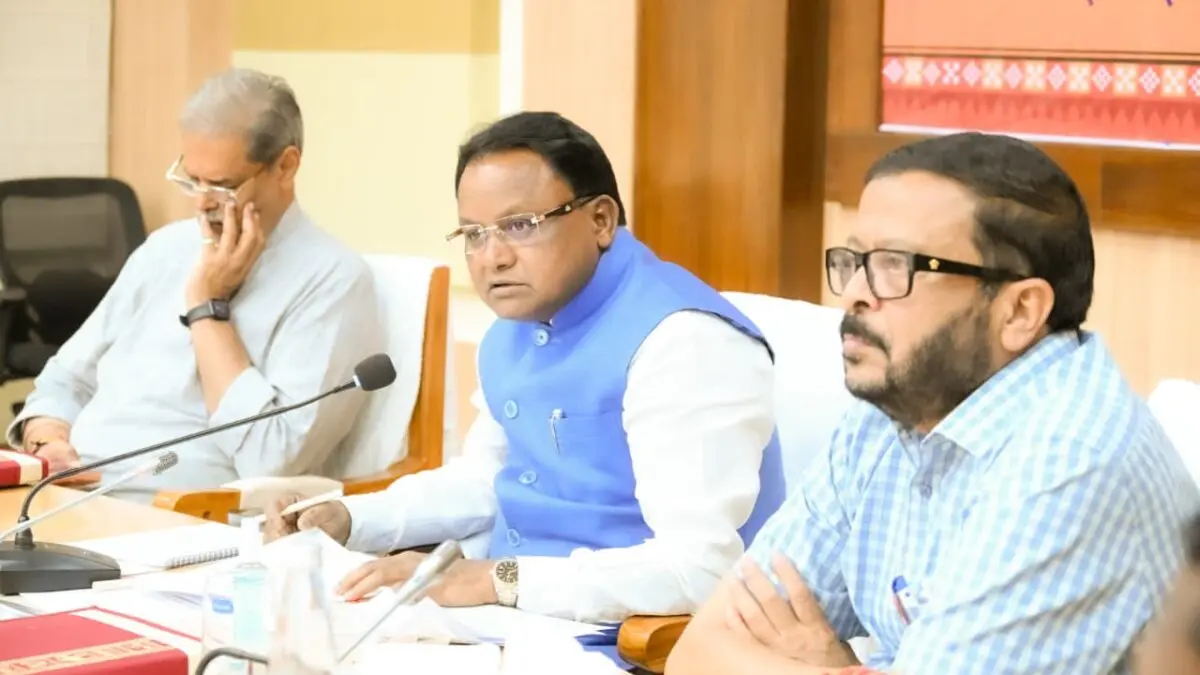
Bhubaneswar: The Odisha government on Monday reviewed its disaster preparedness with Chief Minister Mohan Charan Majhi reaffirming the state’s commitment to “zero casualty” approach to natural calamities.
The review was conducted at the State Level Natural Disaster Committee Meeting-2026 (SLNCC) held at Lok Seva Bhawan Convention Centre,
Chairing the high-level meeting, the Chief Minister said Odisha has developed a “foolproof” disaster management system over the years and stressed the need to maintain and further strengthen it to effectively respond to emerging climate-related challenges.
The meeting, attended among others by Deputy Chief Minister Kanak Vardhan Singh Deo and Revenue & Disaster Management Minister Suresh Pujari, focused on improving inter-departmental coordination under a “Whole of Government” approach for better preparedness and response.
In view of the possibility of below-normal rainfall due to the El Niño effect, the Chief Minister directed the Agriculture, Irrigation and allied departments to prepare a coordinated contingency plan to safeguard the Kharif crop. He also instructed officials to closely monitor rainfall patterns, reservoir levels, crop planning and the availability of seeds and fertilizers.
In view of concerns over a possible global fertilizer shortage due to geopolitical tensions, district collectors were as
ked to closely monitor the supply and distribution of urea and complex fertilizers and ensure adequate availability of nano urea where required. The government has also constituted monitoring committees at the panchayat level to prevent black marketing of fertilizers.
Highlighting past disaster response efforts, Majhi said Odisha’s effective management during Cyclone “Montha” and Cyclone “Dana” demonstrated the state’s preparedness and quick response system. He said around 38,000 people were evacuated to safety during Cyclone “Montha,” with the deployment of 33 ODRAF teams, 5 NDRF teams and 123 fire service units.
The Chief Minister said Odisha’s disaster management model has received appreciation at international forums, including the BRICS Disaster Risk Reduction Working Group meeting held in Puri recently.
He also reviewed infrastructure preparedness, noting that Rs 6 lakh per year has been allocated for the maintenance of 911 multipurpose cyclone shelters across the state. Arrangements for drinking water, electricity and cooking facilities are being ensured in advance.
The Common Alerting Protocol (CAP)-based SMS warning system, 24-hour emergency control room and 112 helpline remain fully functional, he said, adding that efforts must be made to curb misinformation during disasters through timely and accurate communication.
Minister Suresh Pujari highlighted how Odisha has successfully managed natural disasters in recent years, setting a unique example globally. He noted that due to well-planned preparedness and timely rescue operations, the state has been able to effectively uphold the “Zero Casualty” policy.
Reviewing financial assistance and infrastructure requirements for disaster management, he also emphasised the proper utilisation of the State Disaster Response Fund (SDRF). He informed that during recent floods and cyclones, prompt relief and temporary restoration of public property worth crores of rupees were undertaken in North Odisha and flood-affected districts.