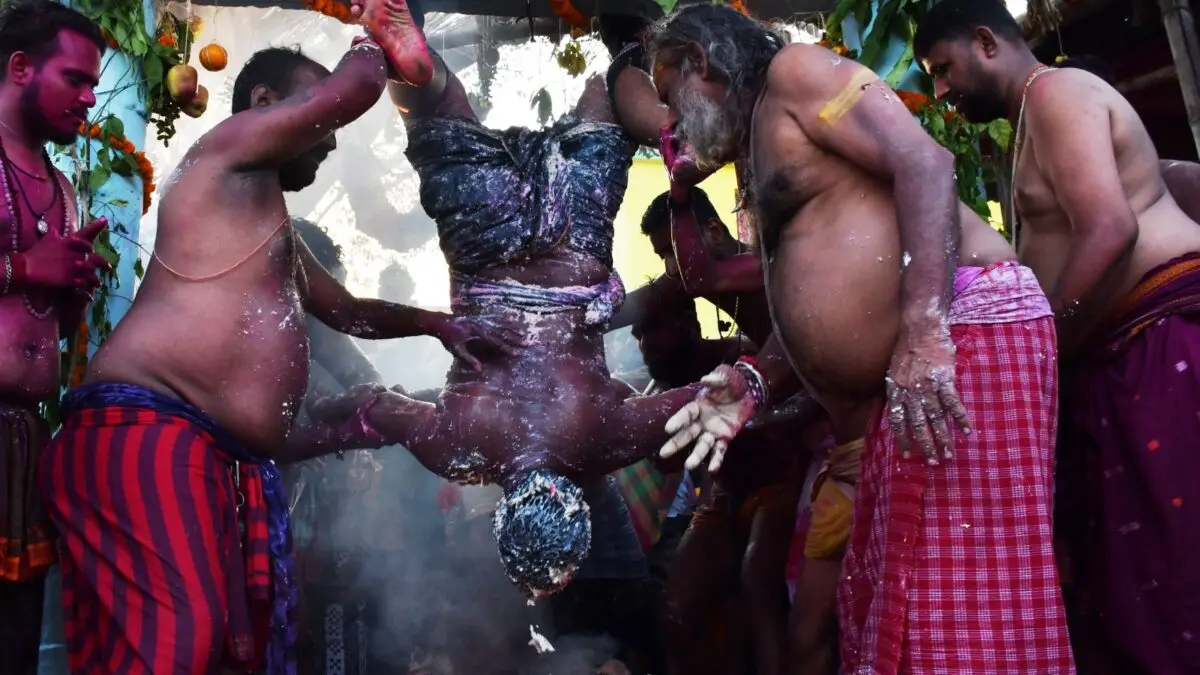
Berhampur: The rhythm of the drums, cymbals and conch shells that reverberated in the air for last 21 days for ‘Danda Nata’ across Ganjam district culminated on ‘Maha Bishub Sankranti’ with a crescendo of religious fervour. It ended with drops of blood offered as a final offering to the mother goddess.
It marks the concluding ceremony of ‘Danda Nata’. It is also called ‘Meru Sankranti’ by the people of Ganjam. The festivities on this day are called ‘Meru Jatra’. It also coincides with the onset of Odia New Year.
The Bhoktas or Danduas, who take up life of hard penance for three weeks and become members of ‘Danda Nata’ troupes, ended their period of extreme austerity and penance on Tuesday. They had left the comfort of their homes to take up the penance in a festive mood in honour of mother goddess ‘Danda Kali’. After ‘Meru Jatra’ they would return to their homes.
People in large numbers gathered at Danda Kali temples in parts of Ganjam district to take part in the final rituals. In Berhampur, ‘Meru Jatra’ was celebrated at Danda Kali temples at Panigrahipentha, Diamond Tank Road, Bijipur, Ambapua, near City Bus Stand, near Aastha Hospital and Anand Sarani. Large crowd gathered in the areas to have a glimpse of the final offering of the ‘Pata Bhoktas’, who lead the ‘Danda Nata’ troupes. After ritualistic baths, the ‘Pata Bhoktas’ were led to the Danda Kali temples by other ‘Danduas’. The ‘Pata Bhoktas’ were blind-folded, their bodies smeared with a special paste comprising turmeric and other herbs. In blind-folded state they were hung above a pit of fire upside down. They were moved till three drops of blood fell from his nostrils into the fire amidst cheers of devotees. “We do not find it difficult to observe all the rules due to the blessings of the almighty,” said a Pata Dandua of the Danda Kali temple near City Bus Stand.
Danduas pray to Goddesses Kali and Lord Shiva for 13, 18 or 21 days of penance. Only male persons take part in this festival. Danduas move around in groups of 21 to over 1,000 and dance in front of houses of persons who invite them. They wear yellow and saffron robes and can be seen rolling on the dust at mid-day with drums being beaten in the background. They do so with a belief that their wishes will be fulfilled if they torture their body.
The dance at mid-day is called Dhuli Danda, while that performed in ponds during the evening is called Pani Danda, while walking on fire at midnight is known as Agni Danda. The Danduas eat only once a day at midnight and do not sleep at night during the festival. The Danduas greet each other as ‘Bhokta’ and ‘Rushi Putra’ while the group leader is called Pata Dandua or Pata Bhokta. The Danduas generally stay near a temple or some sacred place and stay away from their near and dear ones to concentrate on worshiping. They move out from their stay in the morning amidst beating of drums and blowing of conch and trumpet. When they move in rows with red and yellow flags locals seek their blessings.
According to mythology, 13 sons of the great saint Tarani in ‘Tretaya Yug’ practiced self-inflicted ‘punishment’ to appease Lord Brahma who cursed them for their misdeed. Another legend says 13 sons of Indra and Kubera criticized the figure of the great saint ‘Astabakra’ who cursed them to be born in ‘Martya’ and suffer a lot. The son of Indra who took birth as a bird hunter died in snakebite masterminded by Lord Shiva. He helped to kill the bird hunter after the birds prayed to ‘Garuda’ who prayed to Lord Shiva to find a way out. But the bird hunter regained his life after his two wives worshiped Maa Kali and the Goddess prayed to Lord Shiva to give life to the bird hunter. Maa Kali ordered the bird hunter to propagate her dignity.
Historians trace its origin to 8th and 9th century during the inception of Tantrism after the decline of Buddhism in Odisha. “Abhinava Chandrika, a literary work of 1568, mentions the prevalence of Danda Yatra”, said eminent researcher Dr Anantaram Kar Kaundinya.
Worse hit due to Danda Nata are the construction and agriculture works as the labour class and farmers were mostly participating in the festival.