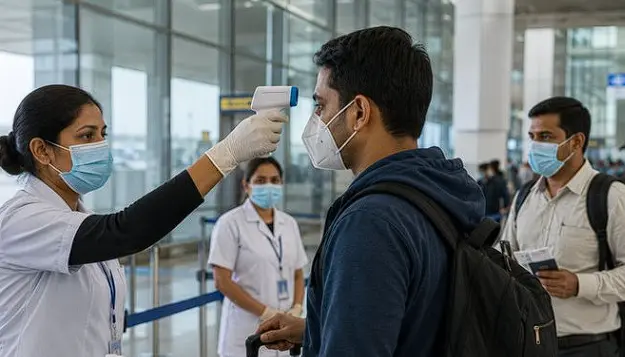
New Delhi: India has intensified public‑health surveillance after the World Health Organization declared an international health emergency over an expanding Ebola outbreak in Central Africa. The Union Health Ministry said no Ebola cases have been detected in India, but enhanced screening is now in place at airports, seaports and other entry points as a precaution.
Airport Advisory, Screening Steps
Meanwhile, citing a Directorate General of Health Services (DGHS) notice, authorities at Delhi’s Indira Gandhi International Airport on Thursday issued an advisory for passengers arriving from or transiting through countries reporting Ebola disease. The Union Health Ministry named the Democratic Republic of Congo (DRC), Uganda and South Sudan as “High Risk Countries.” Passengers who have recently travelled from those countries were urged to report specific symptoms and possible exposures without delay.
Symptoms Checklist For Travellers
The advisory listed tell-tale signs and actions: “Immediately report to the airport health officer/health desk before immigration clearance,” it said.
Travellers were told to watch for fever, weakness or fatigue, headache, muscle pain, vomiting, diarrhoea, unexplained bleeding and sore throat, and to report any “direct contact with blood or body fluids of a person suspected/confirmed to have Ebola Disease.”
Delhi Airport also warned that “any traveller developing the above symptoms within 21 DAYS of arrival should immediately seek medical care and inform healthcare authorities about their travel history.”
Public-Health Rationale, WHO Concerns
The WHO’s declaration follows a rapidly worsening outbreak in the DRC, where officials and international agencies report more than 130 deaths and hundreds of suspected cases linked to the rarely seen Bundibugyo strain of the Ebola virus. The organisation said it is “deeply concerned” by the outbreak’s “scale and speed,” and highlighted weaknesses that could hamper containment: limited testing capacity, shortages of protective equipment and fragile health systems in affected areas.
Although the WHO judged the global risk of spread to be low, it assessed the threat as high at national and regional levels in the affected countries, prompting heightened international monitoring and emergency responses.
Experts Urge Vigilance, Not Panic
Indian experts urged calm, saying there is “no immediate reason for panic,” and noted Ebola does not spread like respiratory viruses such as COVID‑19. They stressed early detection, strict screening of incoming travellers and prompt isolation of suspected cases to prevent importation.
Health officials warned the outbreak involves the rare Bundibugyo strain, and “there are currently no approved vaccines or targeted treatments.” That has pushed governments and aid groups to speed medical shipments and boost response efforts in the DRC and neighbouring Uganda.
India’s stepped‑up screening and the DGHS advisory are designed to keep the country prepared while authorities monitor the situation.
Governments worldwide are monitoring the outbreak closely. Ebola spreads through direct contact with infected bodily fluids such as vomit, blood or semen. This outbreak is linked to the rare Bundibugyo strain.