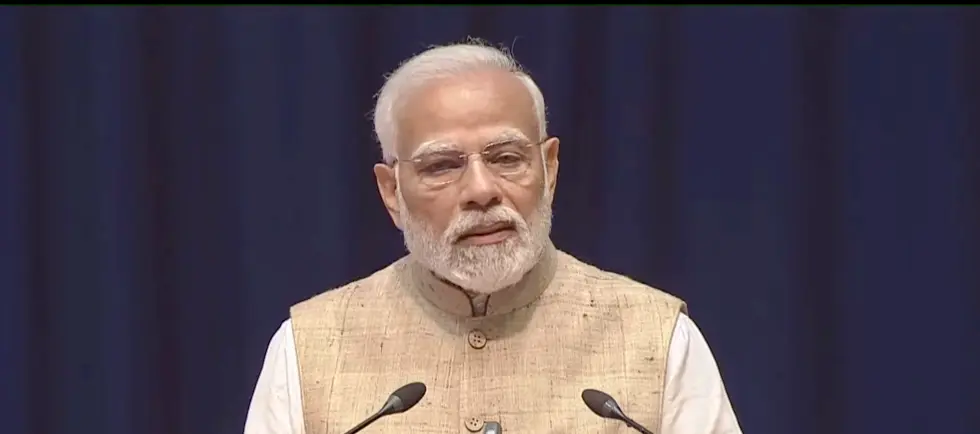
New Delhi: While developed nations produce six times more per capita carbon emissions than India, it is the developing countries that often get unfairly blamed for climate change, Prime Minister Narendra Modi said on Saturday.
He outlined India’s plans to generate more nuclear energy while inaugurating an international conference on environment and climate.
Whenever he takes forward work on nuclear energy generation, those who preach most loudly about the environment actively oppose clean energy solutions by filing court cases, the Prime Minister said.
“We all know that the responsibility for carbon emissions has often been wrongly placed on developing countries. While the historical truth is that even today, India’s contribution to per capita carbon emissions is less than half of the global average,” he said at the two-day event being attended by environmental experts, Supreme Court judges, legal experts and senior government officials.
Developed nations have six times more per capita carbon emissions compared to India and New Delhi strongly presents this fact on global platforms, PM Modi said.
“And I would say to every Indian: You too say this forcefully,” he said.
India is working with the rest of the world and setting new standards for environmental protection, he said, adding that “our development is both speedy, as well as sustainable”.
India is focusing on renewable energy and is the only nation in G20 that has already fulfilled its Paris (COP 21) commitments, well before its timeline, the Prime Minister said.
“This is the power of New India. Non-fossil fuels, solar energy capacity, stoppage on carbon emissions… India’s performance on all such metrics is being discussed across the world,” he said.
In the last 12 years, the country’s wind energy capacity has gone up three times and the hydro energy capacity has also seen a jump and now the country is working at a fast pace on nuclear energy generation, he said.
“And people who give big lectures on environment, when I take forward the nuclear energy work, they will go to courts to stop it,” PM Modi said.
The government is also opening pathways to bring in private players in these sectors, he said.
“With these efforts, India’s non-fossil energy capacity has grown by 400 per cent,” he said.
“Our major focus has been on renewable energy, and this has played a significant role in environmental protection,” he said.
India’s solar energy capacity was only 2 GW 12 years ago and today, it has crossed 160 GW, the Prime Minister pointed out.
Under the ‘PM SuryaGhar Muft Bijli Yojana’, the government has started a mission to transform houses into solar-power generation centres, he said.
“Under this mission, over 50 lakh houses now have rooftop solar panels. This is a number larger than the total number of houses in several countries,” he said.
Prime Minister Modi said his government has provided additional help of nearly Rs 80,000 to every such household with rooftop solar panels.
India’s wind energy capacity has witnessed 3X growth in the last 12 years and the country’s hydro-energy capacity has also seen robust growth, he said.
The country is rapidly working in areas like clean mobility and green hydrogen, he said, pointing to how India’s first hydrogen train started running a few days ago.
It is the world’s longest hydrogen train, PM Modi noted, saying: “This marks the beginning of a new era in clean mobility.”
Before 2014, only 3,000 e-vehicles sold in India every year, he said.
“Last year, nearly 25 lakh EVs were sold; an unbelievable growth. This is helping our environment. With FASTags, waiting time and fuel wastage at toll booths have reduced significantly,” he said.
He referred to the expansion of the metro network, saying how the country had only five cities with metro networks before 2014, covering less than 250 km.
India now has over 1,000 km of metro network across 20 cities and the 100 per cent electrification of railways has also helped the country save crores of litres of diesel, the Prime Minister said, as reported by Deccan Herald.
“That has also helped our environment. Our development is both speedy, as well as sustainable,” he said.
On the “unprecedented” work being carried out in water conservation, the Prime Minister said over 70,000 ‘Amrit Sarovars’ have been built.
“Under the ‘Catch the Rain’ initiative, nearly 1.5 crore water harvesting structures have been built across the nation,” he said.
The national mission on natural farming has also brought about a significant change, PM Modi said.
“Clusters on natural farming have been created across 12.5 lakh hectares. About 3,000 varieties of climate-resilient crops have been developed. We are reducing our carbon footprints by promoting agroforestry. In the last 12 years, our very dense forest cover has grown by 22 per cent,” he said.
Highlighting plastic waste as one of the major challenges for the environment, the Prime Minister said India has already banned single-use plastic and the government is now promoting a circular economy with the mantra of reduce, reuse, and recycle.
“Thousands of tons of waste are being recycled every day in India today. Through the Gobardhan scheme, cow dung and other organic waste in villages are also being converted into useful resources,” he said.