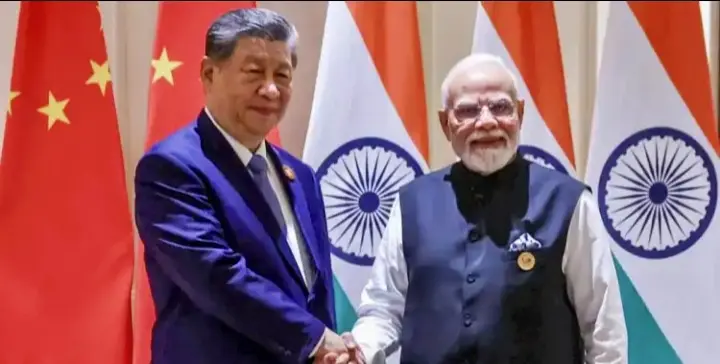
New Delhi: Prime Minister Narendra Modi reportedly assured Chinese president Xi Jinping that India will not allow any forces to engage in activities against China in its territory, Beijing claimed after the two leaders met in New Delhi on the sidelines of the 18th BRICS Summit.
PM Modi also told Xi that India’s position on Tibet and Taiwan remained unchanged, the ministry of foreign affairs of the Government of China said.
The press release issued by the Ministry of External Affairs of the Government of India after the meeting quoted PM Modi telling Xi that both India and China must be guided by “three mutuals – mutual respect, mutual sensitivity and mutual interest”.
It, however, had no reference to New Delhi’s position on the issue of Tibet and Taiwan.
The press release issued in Beijing, however, quoted the Indian PM telling Xi: “India adheres to an independent foreign policy, and its development of relations with China is not influenced by any third party. India’s policies and positions on Taiwan and Tibet remain unchanged, and it will not allow any forces to engage in anti-China activities in India.”
Beijing’s claim about New Delhi’s reassurance on the issue of Tibet and Taiwan came just days after India allowed the Tibetan government-in-exile based at Dharamshala to celebrate its 66th Democracy Day, as reported by Deccan Herald.
The event marked the 66th anniversary of the launch of the democratic system of governance for the exiled Tibetans in September 1960, just over a year after the 14th Dalai Lama escaped from Lhasa to India, foiling the Chinese People’s Liberation Army’s plan to imprison him.
New Delhi also allowed Wang Dan, one of the top leaders of the 1989 pro-democracy uprising at Tiananmen Square in Beijing, to attend the event at Dharamshala, Himachal Pradesh, as the chief guest.
Wang, a well-known critic of the Communist Party of China (CCP), met the Dalai Lama. He accused the CCP of relying on “violence, lies and control” to continue its rule in China.
Though Beijing frowns upon any other nation’s official contacts with Taipei, India also recently signed a Memorandum of Understanding (MoU) on Public Finance Cooperation with Taiwan.
India had earlier been routinely recognising the Tibet Autonomous Region (TAR) as an integral part of China in all the joint declarations and other bilateral documents. India had also been routinely reaffirming its One-China policy, thus not recognising the Republic of China or Taiwan as a separate nation other than the People’s Republic of China.
But, after Beijing started to issue ‘stapled visas’ to people living in Arunachal Pradesh, Ladakh and J&K of India, New Delhi had, in 2010, dropped words of its support for China’s stand on Tibet and Taiwan from the joint communiqué issued after the parleys between the then Prime Minister Manmohan Singh and then premier of the communist country Wen Jiabao.
The June 2020 clash between the Indian Army and the Chinese People’s Liberation Army in Galwan Valley and the military stand-off along the Line of Actual Control in eastern Ladakh between April-May 2020 and October 2024 had prompted clamours for a review of India’s position on Tibet and Taiwan in response to aggressive moves by China.
New Delhi, however, never officially changed its position on Tibet and Taiwan.