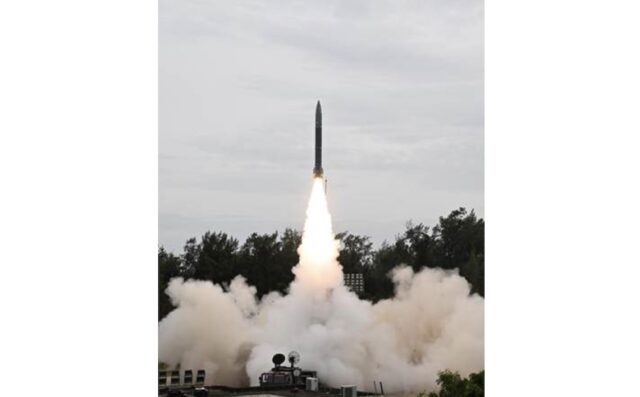
Bhadrak: The Defence Research & Development Organisation (DRDO) conducted two consecutive successful flight-tests of Pralay missile from Dr APJ Abdul Kalam island off Odisha coast on July 28 and July 29.
The flight tests were carried out as a part of user evaluation trials to validate the maximum and minimum range capability of the missile system. “The missiles precisely followed the intended trajectory and reached the target point with pin-point accuracy meeting all the test objectives. All subsystems performed as per expectations, which were verified using test data captured by various tracking sensors deployed by Integrated Test Range (ITR) including instruments deployed on ship positioned near the designated impact point,” a government release said.
The flight-tests were witnessed by senior scientists of DRDO, representatives of the users from the Indian Air Force and the Indian Army as well as the industry representatives.
Pralay is an indigenously-developed solid propellant quasi-ballistic missile employing state-of-the-art guidance and navigation to ensure high precision. It showcases country’s growing prowess in missile technology and its commitment to self-reliance in defence production under the Atmanirbhar Bharat initiative.
The system has been developed by Research Centre Imarat in collaboration other DRDO labs – Defence Research & Development Laboratory, Advanced Systems Laboratory, Armament Research & Development Establishment, High Energy Materials Research Laboratory, Defence Metallurgical Research Laboratory, Terminal Ballistics Research Laboratory, Research & Development Establishment (Engineers) and ITR etc; industry partners – Bharat Dynamics Limited & Bharat Electronics Limited and many other industries and MSMEs.
MORE ABOUT THE MISSILE
Pralay is a canisterised surface-to-surface missile, allowing it to be launched from a mobile platform. This enhances its operational flexibility and survivability, with a launch preparation time of under 10 minutes. It boasts a range of 150-500 km and can carry a payload of up to 1,000 kg.
It is also described as a “quasi-ballistic” missile, which functions as a ballistic missile, launched vertically and following a low trajectory hyperbolic flight trajectory from its firing point to the designated target, but has the ability of the warheads to change course or be manoeuvred in the later stages of its flight, somewhat like a cruise missile.
It is roughly of the same size and weight as that of Prithvi, but a considerably longer range, giving the armed forces the flexibility to strike strategic targets deep inside enemy territory without crossing the nuclear threshold.
Its deployment is aimed at providing credible deterrence and a swift conventional response along Line of Actual Control (LAC) with China and the Line of Control (LoC) with Pakistan, according to reports.