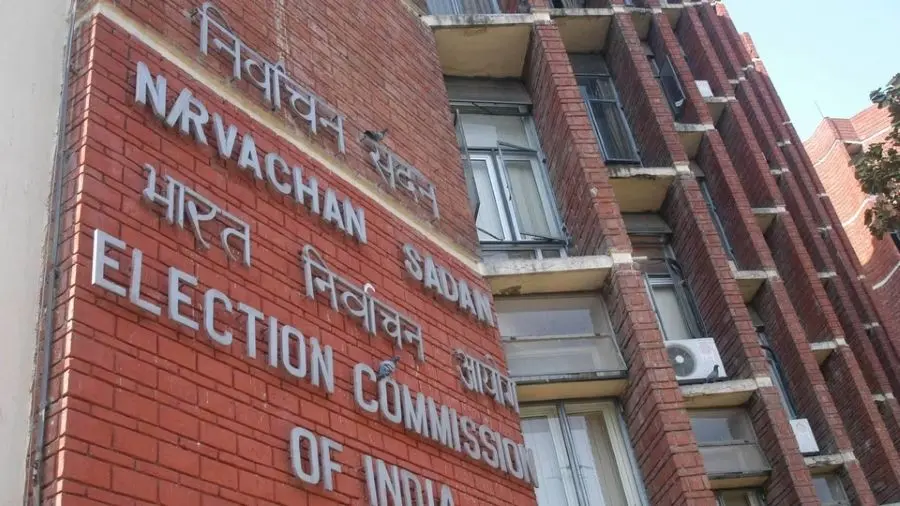
New Delhi: The Election Commission of India (ECI) has filed a counter-affidavit in Supreme Court defending its decision-making process and rejecting allegations that Chief Election Commissioner (CEC) Gyanesh Kumar took important decisions on the Special Intensive Revision (SIR) of electoral rolls without the other two Election Commissioners’ approval.
Contending that the petition challenging the CEC’s functioning was based on a single news report, ECI maintained that the three orders relating to the SIR — issued in June 2025, October 2025 and May 2026 — were approved unanimously by the Commission.
The ECI said the affidavit was approved by all three members — CEC Kumar, and Election Commissioners Sukhbir Singh Sandhu and Vivek Joshi. The Commission added that notes, queries or suggestions made by individual commissioners while files are being processed do not, by themselves, constitute decisions of the Commission.
Explaining its decision-making process, the poll body said files are generally examined first by one Election Commissioner, then the other, before being placed before the CEC. In urgent cases, approvals may be obtained electronically and recorded on the file subsequently.
The affidavit pointed out that observations or queries raised by any of the three members while a file is being processed cannot be treated as a formal decision under Section 18 of the Chief Election Commissioner and Other Election Commissioners Act, 2023.
Form 6 controversy
On the controversy regarding changes to Form 6, used for voter registration, ECI told the court that the form itself had not been amended. It said only the Centre had the authority to amend the prescribed form, while the declaration required for the SIR process was a separate document.
However, the Commission acknowledged that the online presentation of the application could be interpreted as an amendment. It said that from October 21, the online application is being split into Form 6 and the separate declaration, in line with the physical application format.
The ECI also said that voters whose details could not be mapped during the revision won’t ordinarily be required to attend hearings. Booth-level officers (BLOs) would collect the necessary documents from their homes, with hearings reserved for exceptional cases and preferably conducted online.
On the ECINet platform, the ECI said names cannot be added to or deleted from electoral rolls without an order from the Electoral Registration Officer (ERO). It added that a committee involving experts from the Indian Institutes of Technology and the Indian Institute of Science had been formed to examine compliance.
Work allocation order
The ECI affidavit also addressed a July 28 work allocation order issued by an Additional Secretary on deputation to the Commission. The ECI said both Election Commissioners wrote to the Cabinet Secretary the following day, and that the order was never implemented after a joint direction issued by the two commissioners on July 30.