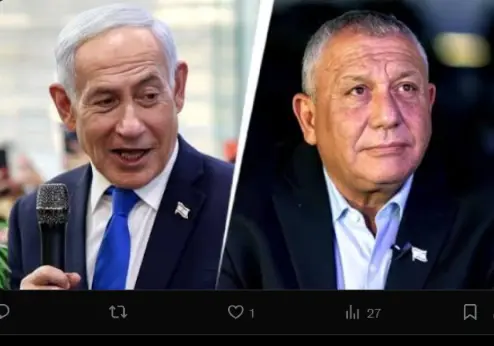
Jerusalem: Gadi Eisenkot, a former army chief who is trying to form Israel’s next government, accused caretaker Prime Minister Benjamin Netanyahu on Friday of encouraging a “racist” campaign against the country’s Arab minority. He said Netanyahu and his supporters were trying to discredit Arab lawmakers by linking them to Hamas, AFP reported.
Eisenkot’s statement was important because it came from a prominent Jewish political leader at a time when Arab Israelis, who make up more than 20 per cent of Israel’s population, have become central to the fight over who will lead the country. He strongly rejected the idea that an entire community should be treated as disloyal or dangerous.
A Direct Challenge
In a message on X, Eisenkot wrote: “Arab citizens of Israel are an integral part of the Israeli story.”
“They have been subjected to a racist and aggressive campaign of delegitimisation, fuelled by the outgoing prime minister and those around him for political purposes,” he added.
“The attempt to marginalise them and vilify them collectively is a profound violation of the principles of civic responsibility.”
His comments followed repeated attacks by Netanyahu and his allies on the leaders of Arab-majority parties. They criticised the leaders for refusing to call Hamas a “terror group” after its October 7, 2023 attack on Israel. All leaders of the Arab parties have condemned that attack, in which Arab Israelis — descendants of Palestinians who stayed in the area that became Israel in 1948 — were also killed.
Netanyahu has also repeatedly claimed that Arab-majority parties committed electoral fraud. Israel’s election authorities have rejected these claims.
Coalition Arithmetic
The political stakes are high. Raam and the Joint List, the two Arab-majority parties, together won 19 seats in last month’s election, nearly one-sixth of the 120-seat parliament. Their support could be decisive in Eisenkot’s effort to form a government.
President Isaac Herzog gave Eisenkot the job of forming a government on Sunday after consultations in which a majority of parties, including the two Arab lists, recommended him. Eisenkot’s bloc has 67 seats on paper, but 19 of those seats belong to the Arab parties.
Avigdor Liberman, a right-wing ally of Eisenkot, has said he will leave the coalition if Arab Israelis are part of it. That makes it difficult for Eisenkot to include Arab parties formally, even though their backing may be needed to keep Netanyahu from returning to power.
Netanyahu’s Attacks
In a speech this week, Netanyahu said the two Arab lists refuse to recognize Israel as a Jewish state. Raam leader Mansour Abbas has said in the past that he does recognize Israel as a Jewish state. Netanyahu also claimed that the parties wanted to create either an “Islamic state” or a “nationalist Palestinian state.”
During the same ceremony, National Security Minister Itamar Ben Gvir interrupted Joint List leader Youssef Jabareen while he was taking his oath of allegiance. Ben Gvir accused him of having “pledged allegiance to Hamas.”
Eisenkot said people can disagree with Arab-party politicians, but they should not attack the whole community. “It is entirely legitimate to disagree with representatives of the Arab parties, even to strongly disapprove of some of them. But it is neither legitimate nor acceptable to malign an entire community, and I will not allow it,” he said.
What Comes Next
Eisenkot has 28 days to form a government. If he cannot do so, he may ask for another 14 days. If he still fails, the task of forming a government would pass to another lawmaker, most likely Netanyahu.
For now, Eisenkot is sending the message that Israel’s Arab minority should not be treated as a political problem. But turning that message into a working coalition will be the main challenge of his effort to become prime minister.
Eisenkot Slams Netanyahu For ‘Racist’ Campaign To Delegitimize Israel’s Arab Minority