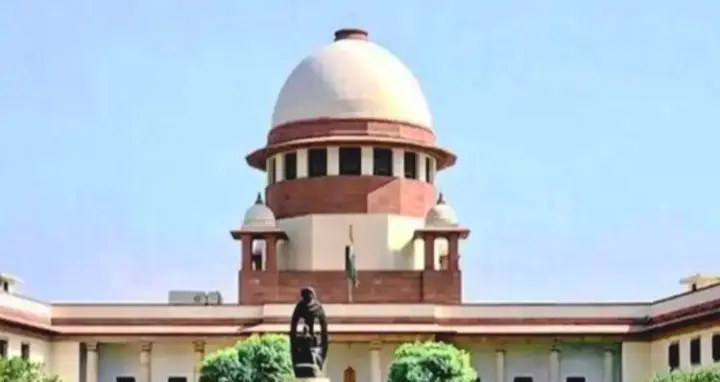
New Delhi: Existing law is adequate to punish hate speech, the Supreme Court noted on Wednesday, while turning down a petition to declare it and rumour mongering as separate offences under the penal code.
The Court underlined the enforcement deficit, while saying that constitutional courts cannot compel the legislature to create laws.
“Creation of criminal offences lies within the legislative domain. The judiciary cannot create new offences in keeping with the separation of powers under the Constitution,” the bench of Justice Vikram Nath and Justice Sandeep Mehta observed.
A petition has filed in 2021 by advocate and BJP leader Ashwini Kumar Upadhyay, seeking the declaration of hate speech as a separate offence. The court has since taken up pleas over hate speech, including during the 2023 Haridwar Dharam Sansad. It has issued interim orders directing police to mandatorily register cases in such matters.
The Court, on Wednesday, dismissed all petitions in the matter, and said that hate speech and rumour mongering arise not from a deficit in law but in enforcement.
“The contention that hate speech is an unoccupied field in law is misconceived. Existing legislation is adequate to deal with hate speech as there exists no legislative vacuum,” the Court held.
Hate speech and rumour-mongering affect the constitutional ideal of fraternity, the bench said. The Court added that it will be open for the government to consider suitable amendments to the law.
The bench also emphasised that the police have a duty to register cases in such matters, citing the Lalita Kumari judgment (2013), mandating registration of cases if any information discloses the commission of a cognisable offence, as reported by Hindustan Times.
“The aggrieved person can also approach the court for registering an FIR [first information report],” the bench said, adding that the legislative architecture is complete.
A magistrate is empowered to direct FIR as a prior sanction required under Bharatiya Nyaya Sanhita sections 196, 197, 298, and 302 of BNS, dealing with words or acts intended to outrage religious feelings or promote enmity, applies at the time of cognisance of the charge and not at the pre-cognisance stage, the Court said.
The Court directed that a copy of the judgment be circulated to all high courts. It left it open to the high courts to consider issuing practice guidelines for implementing the judgment.