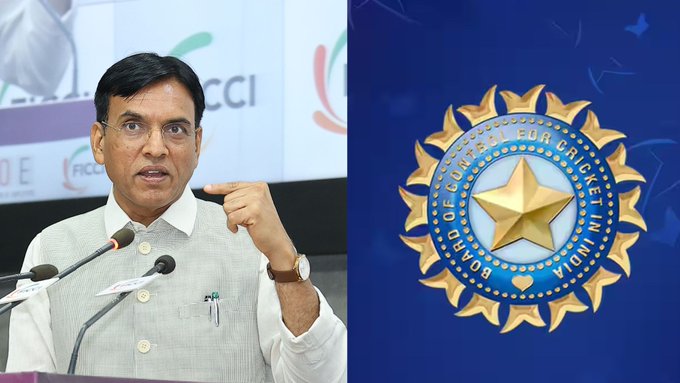
New Delhi: The Indian government presented National Sports Governance Bill 2025 in the Lok Sabha, aiming to change the framework of sports governance. The country has now taken a step towards joining nations like the USA, UK, China, and Japan which have laws in place for streamlined administrative set-ups. The bill, however, has its roots dating back to 2011, the Congress-led UPA was in power.
In 2011, the then Sports Minister Ajay Maken began his push for a legislation to set some benchmarks for the sports administrators, who were and are still accused of corruption and power struggles due to their long-serving tenures. Though Maken had failed to have the bring the bill, it had laid the foundations for the new bill in the form of the National Sports Code.
And when the current sports minister Mansukh Mandviya brought the bill after holding rounds of discussions with the stakeholders, he gave due credit to the sports code. Thus, the objective of the new bill states: “”The National Sports Development Code of India, 2011 established good governance practices for sports bodies, essential for healthy development of sports in the country.”
The new bill aims to bring in accountability through a National Sports Board, a National Sports Tribunal and the National Sports Election Panel. But what is the difference between the Sports Code, 2011 and the new bill?
Age Cap: The Sports Code had capped the age of administrators at 70. The new bill allows an office-bearer to complete his/her tenure if they were less than 70 at the time of filing nominations. A further relaxation of another five years has been made for contesting elections if the international statutes and byelaws allow for it.
Tenure: The Sports Code allowed three terms with a cooling-off period after two terms for the President and two terms for Treasurer and Secretary. According to the new sports bill office-bearers (President, Secretary General and Treasurer) are allowed to serve three consecutive terms of a maximum of 12 years. They remain eligible for election to the Executive Committee even after a cooling off period.
Executive Committee: The sports code had no provision for mandatory women’s representation in the committee which had its strength capped at 15. The new bill mandates that at least four members of the EC must be women, along with two sportspersons of outstanding merit.
Regulatory Body: The sports code had no provisions for a regulatory body to oversee NSFs. But the sports governance bill outlines the creation of a National Sports Board which will fulfill this role.
Some more key features of the bill:
- The bill places a strong emphasis on the inclusion of athletes in decision-making processes. Each National Sports Federation (NSF) will now be required to establish an Athlete Committee, with at least one Sportsperson of Outstanding Merit (SOM) included in its decision-making framework. This guarantees that current or former athletes have a voice in its governance.
- Furthermore, the Bill mandates that federations provide safe and harassment-free environments for athletes by implementing effective internal complaint committees and upholding codes of conduct. These changes arise in response to the rising incidents of athlete harassment and the crucial need for a strong, independent safeguarding system.
- This proposed bill seeks to bring the Board of Control for Cricket in India (BCCI) under its jurisdiction, raising questions about the potential impact on the board’s operations and upcoming elections. This means that the BCCI, will now be required to follow the regulations in respect with the transparency, ethics, and representation—bringing it in line with the standards expected of every other sports organization in the nation.
- Keeping an Eye on the Olympics: This bill supports India’s aspirations for the Olympics. With cricket set a target to be part of the 2028 Los Angeles Olympics, even the influential BCCI is now subject to the regulatory framework of the Indian Olympic Association, and consequently, under the stipulations of the Sports Bill.
Take a look how BCCI will be impacted?
- Roger Binny is not eligible for re-election
Roger Binny, a member of the Indian team that won the World Cup in 1983 and currently serving as the BCCI president, has surpassed the age limit for another term, having turned 70 on July 19.
- Elections are required for Annual recognition
The BCCI is required to conduct elections during its Annual General Meeting in September or October to select a new set of officials. If elections are not held, the government may choose not to renew its annual recognition. Without this recognition, the BCCI would lose the ability to use the name “India” in international competitions or host matches as the official national representative.
Can the BCCI still modify its constitution?
Yes, the BCCI will still have the power to amend its own constitution. Currently, office-bearers are allowed to serve one three-year term, after which they must take a break—a “cooling-off” period for the same length of time before running again.
The National Anti-Doping (Amendment) Bill, 2025
The government has also presented the National Anti-Doping (Amendment) Bill, 2025, in the Lok Sabha, aiming to strengthen the autonomy of the National Anti-Doping Appeal Panel and the National Anti-Doping Agency, ensuring independent decision-making regarding their operations, investigations, and enforcement activities.
“The Director General or any personnel of the Agency shall operate independently of any National Sports Federation, International Federation, National Olympic Committee, National Paralympic Committee, or any government department or agency responsible for sports or anti-doping,” the revised Anti-doping bill states.
The revised bill arrives at a time when India was at the top for the World Anti-Doping Agency’s 2023 testing statistics among nations that processed 5,000 or more samples last month.
India & doping in sports
According to the figures for 2023, India’s positivity rate for prohibited substances was recorded at 3.8 percent, translating to 214 Adverse Analytical Findings (AAF) from a total of 5,606 samples. This sample size represented a notable increase from 2022, when 3,865 tests resulted in an AAF rate of 3.2 percent.
Out of the 5,606 tests conducted, 2,748 were performed during competitions.
India’s positivity rate for banned substances was considerably higher than that of China (28,197 samples, 0.2 percent AAF rate), the USA (6,798 samples, 1.0 percent AAF rate), France (11,368 samples, 0.9 percent AAF rate), Germany (15,153 samples, 0.4 percent AAF rate), and Russia (10,395 samples, 1.0 percent AAF rate).
Athletics topped the list of positive cases in India, registering 61 AAFs from 1,223 samples—567 of which were in-competition urine tests and 539 out-of-competition urine samples, along with 117 blood samples.
Weightlifting recorded 38 AAFs from 451 samples, while powerlifting and wrestling accounted for 28 and 10 AAFs, respectively.