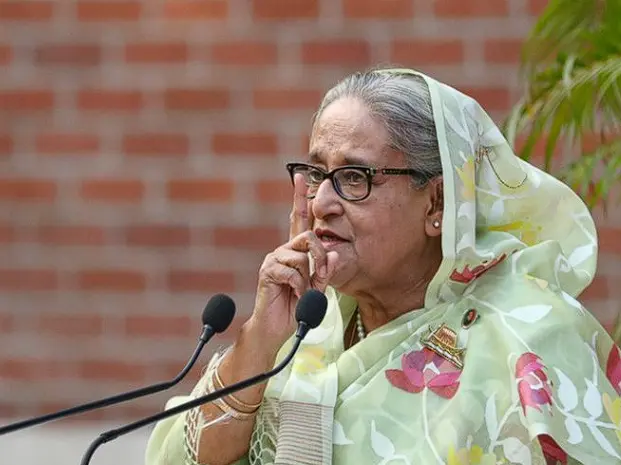
‘Fear Cannot Decide My Duty’: Hasina Vows To Return To Bangladesh Despite Facing Criminal Cases
New Delhi: Former Bangladesh prime minister Hasina on Wednesday said she would return to her country despite a string of criminal cases against her, insisting that “fear cannot decide my duty to the people” as she mounted a fresh defence of her government’s response to the July-August 2024 unrest in her first press conference since being removed from office.
Speaking virtually to reporters from New Delhi, Hasina alleged that the anti-government protests were taken over by extremist and foreign-backed elements in an effort to unseat her elected government. She said the plan had been “divulged by Muhammad Yunus himself” and claimed the student quota stir was later converted into a one-point campaign demanding her ouster.
Hasina rejected allegations that her government had ordered indiscriminate violence against demonstrators, insisting that security forces had shown restraint even as the situation turned chaotic.
She said her administration had tried to settle the quota dispute through talks, challenged the High Court’s ruling and invited student leaders for discussions, but alleged that organised groups had used the turmoil to grab power “outside the ballot box”.
The former premier said the violence during the protests led to the deaths of police personnel, Awami League workers, journalists and ordinary civilians, while accusing “terrorist groups” of carrying out coordinated attacks on state installations and security forces, as reported by The New Indian Express.
Denying that her government was behind the bloodshed, she said law enforcement agencies had acted only to restore order.
Hasina, who fled to India after being ousted in August 2024, said her government had formed a judicial inquiry commission on July 18, 2024 to probe every death and incident of violence during the unrest, but alleged that the interim administration led by Muhammad Yunus stopped the investigation after taking over.
Questioning that decision, she claimed those involved in the violence were given indemnity. “If they truly wanted justice, why did they stop the inquiry?” she asked.
She further alleged that since her removal, thousands of Awami League leaders, workers and supporters, along with police personnel, journalists, lawyers, judges and members of minority communities, had been subjected to arrests, torture and violence.
Hasina said the 2024 movement had ultimately become “a coordinated assault on the Constitution” and accused the present regime of cracking down on dissent while targeting those linked to Bangladesh’s Liberation War.
Hasina also claimed that Bangladesh’s economy had worsened sharply over the past year. She said GDP growth had slowed, industrial production had contracted for the first time in decades, bank defaults had increased, poverty had risen and investment had weakened. She claimed the administration was borrowing 700-900 crore taka a month from Bangladesh Bank just to stay afloat, at a time when factories were folding up and many industrialists and business owners had disappeared from public view.
Despite the cases against her, Hasina said she was determined to go back to Bangladesh, insisting that “fear cannot decide my duty to the people.” She added that her return was “not about power” but about restoring “security, development, prosperity and peace” and putting Bangladesh “back on the right track.”
Hasina said history would ultimately judge the events surrounding her fall and vowed to continue speaking out against what she described as an “unconstitutional seizure of power.”