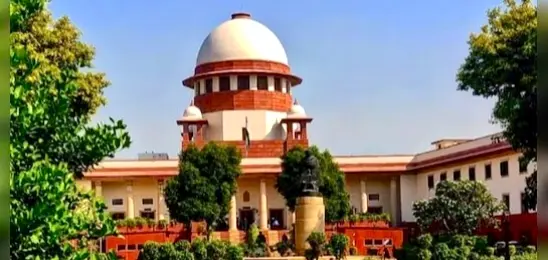
New Delhi: The Supreme Court, on Thursday, directed higher education institutes (HEIs) across the country to fill all vacant positions of vice-chancellors, registrars, faculty and other key institutional/administrative positions within four months.
HEIs have also been directed to remain fully compliant with all regulations that have a binding effect on them, including inter alia, the UGC Regulation on Curbing the Menace of Ragging in Higher Educational Institutions, 2009, and other related provisions.
“Keeping in mind the faculty shortages which have been reported in several HEIs, both public and private, it must be ensured that all vacant faculty positions (both teaching and non-teaching) be filled within four months, with priority given to posts reserved for candidates from marginalised and underrepresented communities, including those reserved for PwDs,” the bench of Justice J B Pardiwala and Justice R Mahadevan directed.
“Special recruitment drives may be held for faculty recruitment that comes under various forms of reservations as per central and state government rules,” the Court said.
“Appointment and filling of vacancies of the post of vice-chancellors, registrars, and other key institutional/administrative positions, must also be made within four months. Moreover, it must be ensured as a matter of practice that these positions are filled within one month of the date on which the vacancy arises, in order to ensure the smooth functioning of HEIs,” the bench observed.
“Since the date of retirement is known much ahead in time, recruitment processes must begin well in advance to ensure that such posts do not remain vacant for more than a month. All HEIs must report on an annual basis to the central and relevant s
tate governments, as to how many reserved posts are vacant, how many are filled, reasons for non-filing, time taken, etc., so that periodic accountability is ensured,” it added.
“The backlog of any and all pending scholarship disbursements must be cleared within four months by the relevant central and state government authorities. If there exists any reason behind the non-disbursal of the same, a notice with reasons must be sent to the relevant HEI along with the student recipient, within a period of two months. It must be ensured that the disbursement of all future scholarships is done with clear timelines, without any delay by the relevant central and state government authorities,” the Court ordered.
The bench also directed all HEIs across the country to report any suicide or unnatural death of a student to the police authorities as soon as they come to know about the incident, noting that the institutes cannot shirk away from their fundamental duty to ensure that their campuses as a whole are safe, equitable, inclusive and conducive spaces of learning, as reported by The Tribune.
It also directed the HEIs to submit an annual report of student suicides or unnatural deaths to the University Grants Commission (UGC) and all other relevant regulatory bodies for professional courses.
“No student should be prevented from appearing in an examination, removed from hostels, barred from attending classes, or have their marksheets and degrees withheld because of delays in disbursal of scholarships. Any such institutional policy may be viewed strictly,” the bench said.
The directions are based on the recommendations of a National Task Force (NTF) set up last year to address the mental health concerns of students and prevent incidents of suicides and said the duty of colleges was not just to ensure academic excellence of the students but also their mental well-being.
The Apex court also directed that the sample registration system data on suicides, especially those falling within the age group of 15-29 years, must be centrally maintained for better and more accurate estimates of deaths by suicide of students in HEIs.