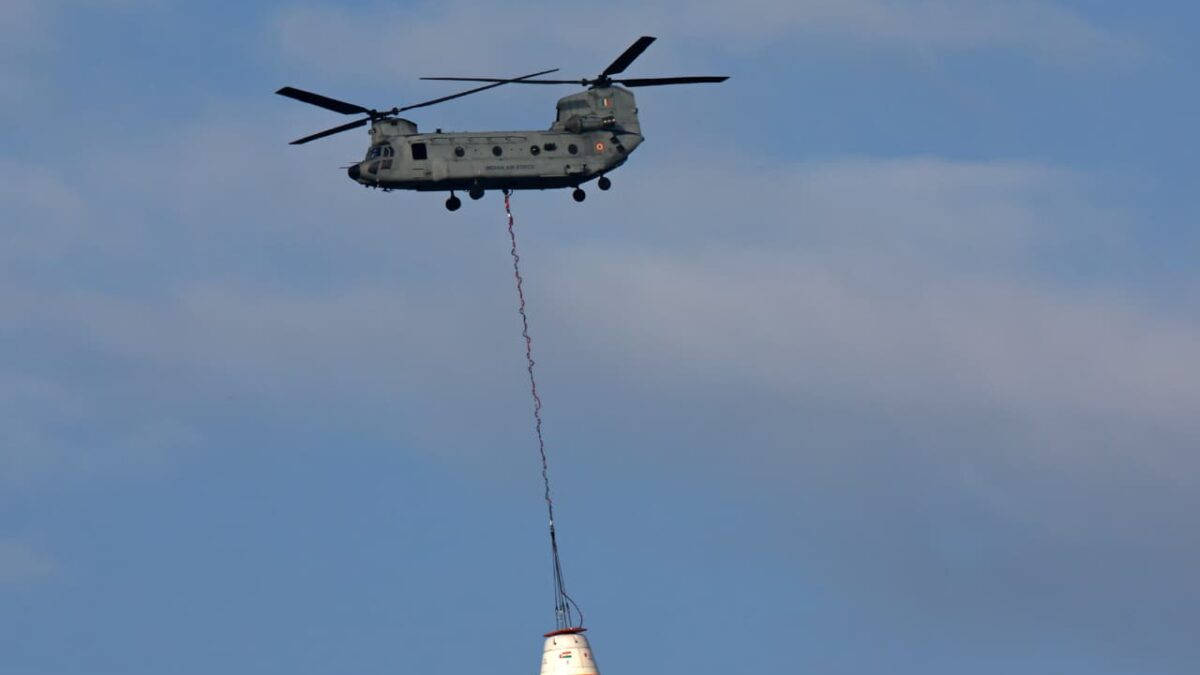
New Delhi: In a landmark step towards ensuring that astronauts return to Earth safe, the Indian Space Research Organisation (ISRO) has successfully accomplished first Integrated Air Drop Test for end-to-end demonstration of parachute based deceleration system for Gaganyaan missions on Sunday.
According to ISRO, the demonstration was carried out in coordination with the Indian Air Force, Defence Research and Development Organisation (DRDO), Indian Navy, and Indian Coast Guard.
“ISRO successfully accomplishes first Integrated Air Drop Test (IADT-01) for end-to-end demonstration of parachute based deceleration system for Gaganyaan missions. This test is a joint effort of ISRO, Indian Air Force, DRDO, Indian Navy and Indian Coast Guard,” it posted on X.
What’s the significance?
The parachute system is crucial for controlled recovery of the crew module after atmospheric re-entry. During the test, a mock module was released from an aircraft and safely descended under the guidance of the newly developed parachute assembly, successfully proving its performance, reported India Today.
The mission proved the ability of indigenous parachute systems to safely decelerate and land heavy payloads, paving the way for crew module recovery in upcoming human spaceflight programmes, according to experts.
The success is seen as vital for ensuring astronaut safety, enabling cost-effective spacecraft reuse, and boosting India’s preparedness for manned missions. Experts say the breakthrough also has strategic value, strengthening aerospace capabilities and opening avenues for commercial applications such as space tourism, satellite return services, and scientific experiments.
December deadline for Gaganyaan test flight
According to reports, ISRO chairman V Narayanan confirmed that India’s first uncrewed Gaganyaan mission, G1, will conduct its test flight in December. It is being planned that the flight test will be done with half-humanoid robot Vyommitra on board, as reported by News On Air.
Narayanan had told reporters in New Delhi at a press conference that Gaganyaan was progressing well. Various reports claimed that about 80 per cent of tests, or around seven thousand 700 tests, had been conducted so far. Over 2,000 more tests are expected to be completed by next year.
Union minister of state for Science and Technology Jitendra Singh had also said the development and ground testing of the Human Rated Launch Vehicle (HLVM3) for India’s first human spaceflight mission, Gaganyaan, had been successfully completed, reported ANI.
What’s in the pipeline?
Gaganyaan-1 will feature a human-robot mission with Vyommitra taking off for space. India plans its first crewed Gaganyaan flight in 2027. It will be followed by Chandrayaan-4 in 2028, a Venus mission. India has also proposed Bharat Antariksh Station by 2035, the minister had said. India also aims to place an Indian astronaut on the Moon by 2040.