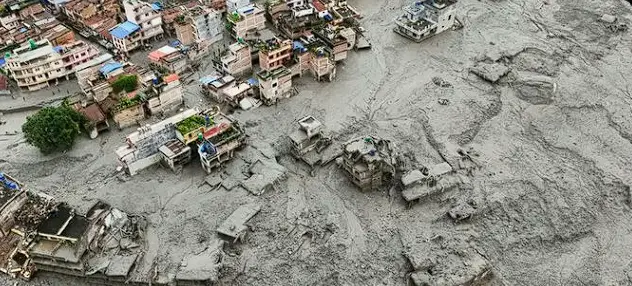
New Delhi: India is rushing emergency aid and reconstruction grants to Kathmandu following Nepal’s catastrophic floods earlier this year, seizing a strategic opening to restore its clout just as Prime Minister Balendra Shah’s Gen Z-backed government confronts its defining test in office.
Bilateral ties had eroded over the past decade due to boundary friction and lingering bitterness over a 2015 border blockade—an event many Nepalis blamed on New Delhi for choking off vital fuel and supply lines, though India has consistently denied involvement. Over that same stretch, Beijing steadily widened its footprint across the Himalayan nation, flooding Nepali markets with electronics and electric vehicles while expanding its reach into infrastructure, healthcare, and education.
Wedged between Asia’s two giants, landlocked Nepal has long served as an arena of geopolitical competition. China’s economic ascent handed Kathmandu fresh leverage to balance its neighbors, upending New Delhi’s longstanding assumption that shared geography, deep economic integration, and Hindu cultural ties would automatically guarantee Indian primacy.
Now, the August floods have handed Indian Prime Minister Narendra Modi a clear opening to regain lost strategic ground. India was the first foreign power to mobilize after one of Nepal’s worst recorded natural disasters, dispatching urgent relief materials and helping restore crippled communications networks.
On Monday, New Delhi followed up that emergency response with a $1.62 billion package of grants and lines of credit earmarked for reconstruction, infrastructure, and energy. The commitment was unveiled as the 36-year-old Shah visited New Delhi for his first bilateral trip abroad since assuming office in March.
With Kathmandu facing an estimated $5 billion rebuilding bill—roughly a tenth of its entire economy—Foreign Minister Shisir Khanal noted in a statement that India’s pledge represents the largest single financial assistance package Nepal has ever secured. According to Nepali government figures, Indian aid disbursements to Kathmandu already outpaced China’s by more than four to one during the 2024–25 fiscal year ending in mid-July.
India-Nepal affairs specialist Ashok Mehta noted that the massive injection of funds could shore up Shah’s domestic standing while allowing New Delhi to reset bilateral relations, much as it did with Sri Lanka during its 2022 economic collapse. “This resembles the Sri Lanka model. India-Sri Lanka ties are now stronger than ever, whereas before Sri Lanka’s turmoil, relations were at a low point,” Mehta observed.
New Delhi has deployed similar economic diplomacy elsewhere in its neighborhood. Maldivian President Mohamed Muizzu initially angled to pull his Indian Ocean archipelago closer to Beijing, only to later hail India as his country’s most indispensable partner. Atlantic Council analyst Michael Kugelman attributed that pivot directly to the financial lifeline India extended during a period of acute economic strain, noting that smaller South Asian nations still lean heavily on Indian development aid.
That regional reliance endures despite Beijing’s far deeper global pockets. Data from AidData shows Chinese state institutions committed nearly $2.2 trillion in overseas loans and grants between 2000 and 2023, dwarfing India’s roughly $46 billion in grants and concessional credit. Yet while Beijing’s financing tilts heavily toward large, state-backed infrastructure lending, New Delhi has paired grants and soft loans with rapid disaster relief.
The India-China rivalry
For Indian policymakers, the contest in Kathmandu is increasingly less about shutting Beijing out altogether than ensuring China’s commercial weight does not harden into political dominance. Bilateral trade between China and Nepal has more than tripled over the last ten years, fueled largely by Chinese imports. Beijing has also cultivated soft power, with the Confucius Institute at Kathmandu University teaching Chinese language and culture to roughly 50,000 high school students since 2007.
Following the August deluge, Beijing delivered cash, five shipments of relief goods, and over 20 rescue and forensic specialists, alongside meteorological, hydrological, and geological data, Chinese Foreign Ministry spokesperson Guo Jiakun detailed in a Monday Q&A transcript.
Even so, Shah’s New Delhi trip reaffirmed India’s enduring centrality to Nepal’s new leadership. Calling India a “dependable and trusted neighbour,” Shah courted Indian investors and inked agreements expanding collaboration in education, satellite communications, and sustainable urban development.
Former Nepali Times editor Kunda Dixit noted that New Delhi is actively cultivating goodwill with an “enigmatic” new leader it is still working to read. “The Indians may be trying to ensure that he does not lean too much towards China,” Dixit said, characterizing the aid push as an attempt to “reformat relations with Nepal.”
For his part, Shah emphasized that rebuilding mutual confidence must anchor the relationship after years of diplomatic whiplash. “May the friendship between Nepal and India be one where trust stands as tall as the Himalayas,” he declared.