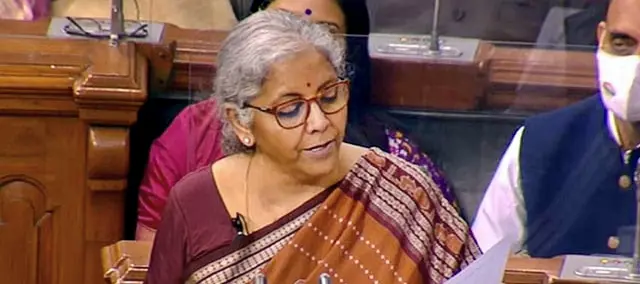
New Delhi: Union finance minister Nirmala Sitharaman asserted on Sunday that the Union Budget 2026-27 is driven by “Yuvashakti” and based on “three kartavyas,”, while proposing seven high-speed rail corridors, new dedicated freight corridors, and the operationalisation of 20 national waterways over the next five years.
Her budget speech outlined a major push for environmentally sustainable passenger transport, proposing the development of seven high-speed rail corridors across key urban and economic centres. These corridors will act as growth connectors, cutting travel time, reducing emissions, and supporting regional development.
The proposed routes include Mumbai-Pune, Pune-Hyderabad, Hyderabad-Bengaluru, Hyderabad-Chennai, Chennai-Bengaluru, Delhi-Varanasi, and Varanasi-Siliguri. Together, they will link India’s financial hubs, technology centres, manufacturing clusters, and emerging cities through faster, cleaner mobility.
“In order to promote environmentally sustainable passenger systems, we will develop seven high-speed rail corridors between cities as growth connectors, namely Mumbai to Pune, Pune to Hyderabad, Hyderabad to Bengaluru, Hyderabad to Chennai, and Chennai to Bengaluru. Delhi to Varanasi, Varanasi to Siliguri,” the FM said.
The Budget also highlighted eco-tourism and nature-based travel. “India has the potential and opportunity to offer world-class trekking and hiking experience,” the minister said.
The government will develop sustainable mountain trails in Himachal Pradesh, Uttarakhand and Jammu and Kashmir, as well as in Araku Valley in the Eastern Ghats and Pudigai Malai in the Western Ghats.
In addition, special trails will be created for wildlife tourism. These include turtle trails along nesting sites in Odisha, Karnataka and Kerala, and bird-watching trails around Pulicat Lake.
The government will also establish new dedicated freight corridors connecting West Bengal’s Dankuni in the east to Surat in the west.
“Establish new dedicated freight corridors connecting West Bengal’s Dankuni in the ea
st to Surat in the west. Operationalise 20 new national waterways over the next five years to promote environmentally sustainable cargo movement,” FM said.
This move aims to shift a greater share of freight to inland water transport, which is considered more energy-efficient and cost-effective than road and rail.
In her speech, Sitharaman said the government remains committed to continuing reforms and ensuring steady momentum in economic policymaking.
“The reform express is running on its way and will maintain its momentum to help us fulfill our Kartavya,” Sitharaman said.
Under the first Kartavya, the government has identified six key areas for focused interventions too accelerate and sustain economic growth, . These interventions, she said, are aimed at strengthening the economic foundation and supporting long-term growth.
The Finance Minister’s first area of focus is scaling up manufacturing in seven strategic and frontier sectors. She said this step is aimed at strengthening India’s manufacturing capabilities and enhancing its position in critical sectors of the economy.
The second proposed intervention focuses on rejuvenating legacy industrial sectors. Sitharaman said that reviving and strengthening traditional industries remain important for sustaining growth, preserving jobs, and supporting regions that depend on these sectors.
The third area of intervention is the creation of champion micro, small and medium enterprises (MSMEs). The Finance Minister said MSMEs continue to play a vital role in economic activity and employment, and supporting their growth is essential for broader economic stability.
The fourth intervention announced in the budget speech is delivering a powerful push for infrastructure. Sitharaman said infrastructure development remains a key pillar for economic expansion, supporting both short-term activity and long-term productivity.
The fifth area focuses on ensuring long-term security and stability. The Finance Minister said maintaining stability is crucial for sustaining growth and building confidence across the economy.
The sixth and final proposed intervention is the development of city economic regions. Sitharaman said these regions will play an important role in driving economic activity and supporting growth across urban centres.
The Finance Minister said these six interventions together reflect the government’s commitment to fulfilling its Kartavya and maintaining the momentum of reforms.