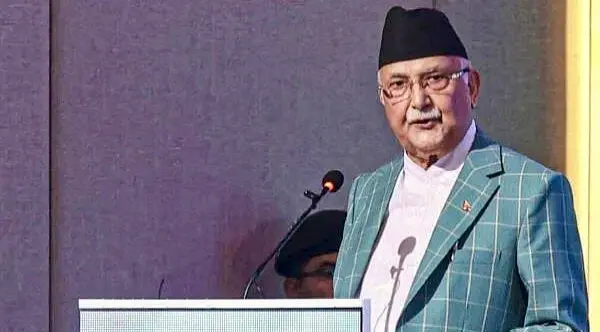
Bhaktapur: K P Sharma Oli, the former prime minister of Nepal, has hinted at India’s role behind the Gen-Z protests that led to his ouster earlier this month.
Without naming India, Oli wrote about a “deliberate infiltration by conspirators” on Facebook after being flown by an army helicopter from the Shivapuri military barracks to Bhaktapur, where a house has been rented for him.
He left the PM’s official residence in an army helicopter after the protests on September 8 and 9. He was kept safe in the military barracks in Shivapuri thereafter.
“Infiltration took place during GenZ’s demonstration that was supposed to be peaceful… Conspirators who infiltrated it instigated violence, killing our youth,” he said, referring to the deaths of protesters.
“The government had not ordered the protesters to be shot. The incident of shooting with automatic weapons that are not with the police should be investigated,” he added.
Oli also accused unnamed forces of trying to destabilise the nation by attacking its core symbols and institutions. He referred to the burning of national landmarks and symbols after his resignation as PM as evidence of a deeper subversion.
“Singha Durbar is burnt after my resignation from the prime minister’s post. Nepal’s map is burnt, trying to erase the country’s sign,” he wrote.
“People’s representative organisations, courts, business establishments and political parties’ offices, homes of their leaders and workers, personal property has been turned to ashes.”
He also said that much of what was said in the protests was “a false narrative”.
“Won’t speak much today about the conspiracy behind these events. In time, many things will reveal themselves on their own. But we must ask: was our nation being built, or being torn down? Was this simply outrage inflated by a false and misleading narrative?”
“Our new generation will come to understand the truth for themselves. And time will remind those who look down upon the youth leaving the country that their judgments were misguided. Eventually, the new generation will see it all for what it truly is,” he added.
Oli also referred to the 2015 blockade along the country’s southern border and the country’s deals with China. This happened after the country’s constitution came into being.
“The constitution was introduced overcoming the blockade and the challenges arising over the country’s sovereignty,” Oli wrote in Nepali.
Between September 2015 and February 2016, Nepal faced a severe blockade at its southern border during which trucks carrying fuel, medicine and other vital supplies were barred from entering the nation. The blockade was led by ethnic minorities who said they were discriminated against in the new constitution. It caused severe shortages of essential goods. Oli had then raised the issue internationally, including with the UN.
India had, at the time, denied blocking supplies to Nepal, saying that the obstructions were by the Nepalese population on the Nepalese side.
The former prime minister said the blockade served as a turning point in Nepal’s foreign policy and infrastructure strategy.
“After the constitution was issued, transport structures connecting the north and south were built to ground the landscaped country so that no one could block Nepal,” he wrote.
He also focussed on a significant shift towards engagement with China during his leadership.
“We had also made a transport deal with the northern neighbouring country,” he wrote, referring to the 2016 Transit and Transport Agreement with China.
We had expanded the capacity of our sovereignty. We laid the foundation of our development structures. The economy was trembling.”
Oli characterised these moves as part of a broader effort to reduce dependence on a single neighbour and ensure that Nepal’s independence could not be undermined by external pressure.
In his address, Oli warned that if Nepalis fail to recognise the seriousness of the current moment, the country risks becoming a cautionary tale. “This must be understood before time runs out. If not, the sovereignty of our country will remain only in history.”