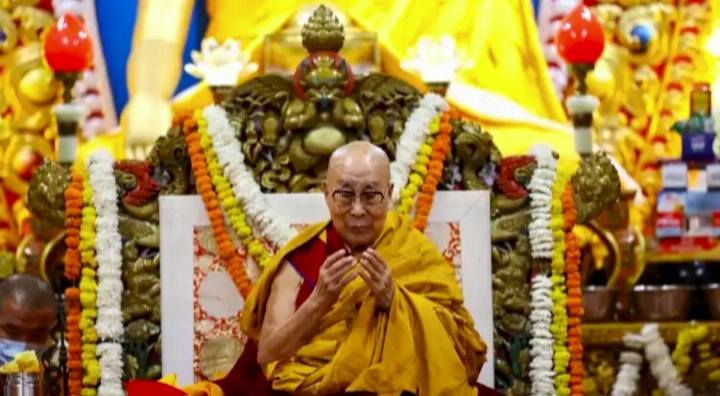
Leh: “In China, the political situation is unstable, even though interest in Buddhism is growing. But where there is no freedom, it is difficult to truly teach Dharma. That’s why I believe teaching in India is more effective,” the Dalai Lama said after returning to his Shewatsel residence on the outskirts of Leh in Ladakh from Dharamshala on Saturday.
In his address, steeped in gratitude, historical reflection, and spiritual counsel, the Tibetan spiritual leader – who celebrated his 90th birthday recently – underscored India’s crucial role in preserving the Tibetan Buddhist tradition, saying that freedom in India has allowed exiled Tibetans to rebuild what was nearly lost under Chinese repression.
His statement comes days after China made it clear that it would have a say in the selection of the next Dalai Lama. The Tibetans are against such interference and the Dalai Lama has made it clear that his successor will be chosen by a trust.
Global interest in Tibetan Buddhism is continuing to grow and people across the world are now paying more attention to the Tibetan issue and China’s stranglehold over the region.
“I’ve received many invitations to visit China, but I feel it would be difficult to teach Dharma in a country where there is no real freedom. It is far more effective to teach Buddhism in India,” the Dalai Lama said.
He recalled how the Chinese authorities systematically dismantled Tibet’s centuries-old traditions of rigorous philosophical study. In contrast, he said, the freedom India offers has made it possible to rebuild centres of learning that carry forward the essence of Tibetan Buddhism.
“When I fled Tibet in 1959, I left behind a great monastic culture. But the Government of India has been incredibly supportive. With their help, we have re-established monastic institutions and continued the legacy of the great treatises,” he said.
Reflecting on his departure from Lhasa, he described the harrowing moment when he left Norbulingka Palace under the cover of night.
“I consulted the Nechung Oracle, performed divinations, and decided to leave. As we crossed the pass, I looked back at Lhasa-a once-great centre of learning now under tight Chinese control. It was deeply saddening. But sadness alone achieves nothing. Once I reached the Indian border, I resolved to channel all my efforts into preserving our culture and building institutions that would uphold our traditions. And we’ve done quite well,” the Dalai Lama said.
Urging people of the trans-Himalayan belt, who share strong linguistic, religious, and cultural ties with Tibet, to continue upholding these traditions, the spiritual leader said: “In Tibet, many who remained suffered severe restrictions. But here, in free India, we have the opportunity-and the responsibility-to preserve these precious teachings.”
“Our ancestors – great practitioners – immersed themselves in transformative spiritual disciplines. Today, that is difficult inside Tibet. That is why it is vital for Himalayan communities to carry forward this torch,” he added.
Encouraging continued learning in the Himalayan region, the Dalai Lama recommended deeper study of Madhyamaka (the Middle Way) and Pramana (logic and epistemology), both cornerstones of the Nalanda tradition.