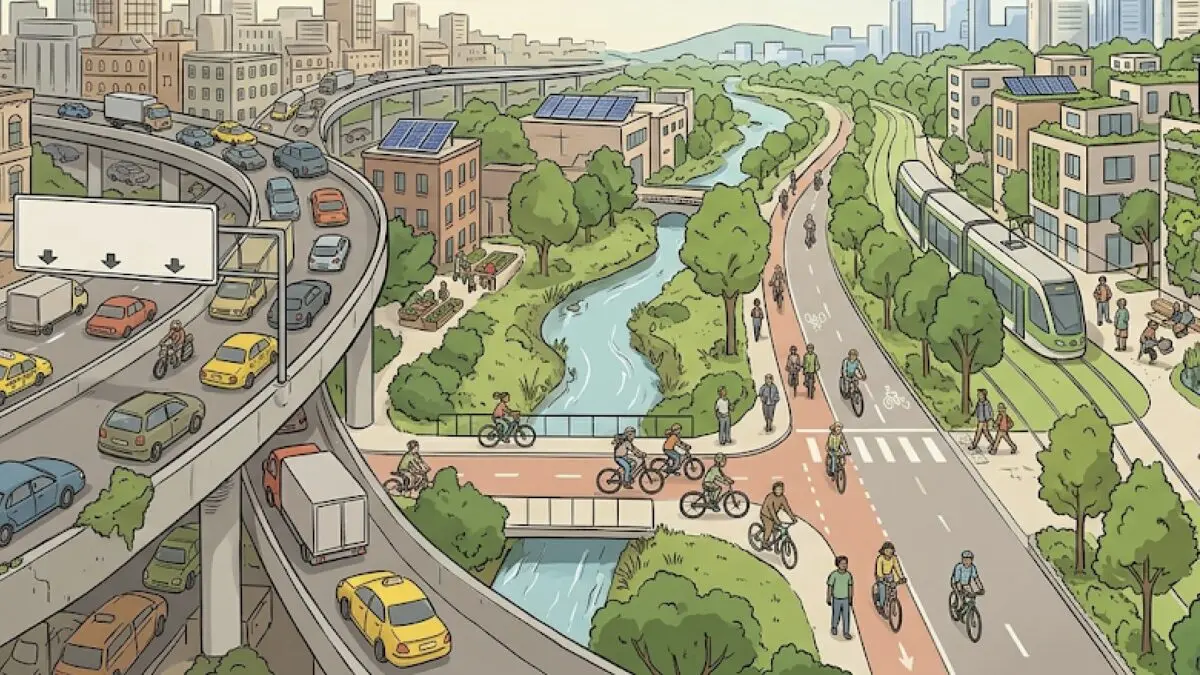
What comes to mind when you think of the city of the future? Back in the 1970s, many people imagined that within another 50 years, the streets would be filled with flying cars, towering skyscrapers, and engineering feats of impossible forms. Now that we are living in that present, the image of the city of the future looks very different, at least if we are talking about a sustainable one.
Today we want fewer cars, more green spaces, resilient infrastructure, and cities that function according to the principles of the circular economy.
We are all living in an era of “Think Globally – Act Locally”. The slogan was coined decades ago, yet it has never been more relevant than now, as the world confronts a global climate crisis. In the same way, the post-pandemic years have led people to rediscover their immediate neighbourhoods and, above all, the places where they live. What the global health crisis of 2020–2021 and the ongoing climate crisis have taught us is the deep interconnectedness of global and local challenges, the interdependencies of health, food and energy systems, and the vital role that cities and communities play in responding to crises.
When it comes to building urban resilience, the importance of local leadership and local institutions cannot and must not be underestimated. Cities are the places where national and global decisions ultimately land and take effect; they must therefore be given corresponding weight in policy and planning.On this World Town Planning Day, the concept of the regenerative city offers a genuine paradigm shift: moving away from car-dependent planning toward a people-centred approach that places nature at its heart.
In another decade, around 40 per cent of Odisha’s population is expected to live in urban settlements. The state’s towns and cities urgently need to transform their neighbourhoods. Planning for systemic, future-oriented and just change must recognise that individuals and communities are indigenous to particular places and must incorporate those native attributes into the planning process.
Both public authorities and urban planners therefore need efficient policies that can accommodate new households, support economic activity and expand infrastructure while preventing unnecessary land take and its damaging consequences. The scope of urban planning has long since expanded beyond bricks and buildings; it is the framework through which visionary leaders shape the future they desire.
Urban planners no longer measure cities primarily by distance, but by accessibility measured in seconds and minutes. Moving from mere redensification — simply packing more people, buildings or floor area into existing footprints — to genuine reimagination, meaning holistically redesigning how space, ecology and communities function. This shift turns urban planning from a numbers game into a human- and nature-first strategy.
Every town and city should be planned for people, not just for their cars. More roads do not always mean better mobility; sometimes they simply mean more traffic in more expensive places. The ultimate goal of urban planning is not to move more vehicles, but to move people. It is time to give citizens cleaner air, safer streets and a higher quality of life. That is the real challenge facing urban planners today.
As urban planners we play a crucial role in creating liveable, high-quality cities with resilient neighbourhoods—exactly what citizens and governments now expect from the profession more than ever before. At the same time, rapid urbanisation and the climate crisis give us the opportunity to measure what matters most: finding better ways to demonstrate the value of good city planning and how it helps create sustainable communities in which people can live happily while advancing the aspirations of a billion Indians.Consider what is happening in Bhubaneswar. Independent India’s first planned capital city has converted its natural drainage systems into artificial sewerage networks and is now bulldozing neighbourhoods in the name of redensification. At the same time it is opening land for construction through town-planning schemes that appear to ignore many of the values of modern urban planning and to revert instead to the thinking of the 1970s.
By contrast, the city of Utrecht is building the Netherlands’ first high-density, car-free residential district for more than 12,000 people, one of the largest projects of its kind in the world. The 24-hectare site, located between two canals in the heart of the city, is expected to strengthen Utrecht’s reputation as the cycling capital of Europe. The Dutch city built the country’s first bicycle lane in 1885; the new Merwede district of 6,000 homes is designed to be served by some 20,000 bicycles.
The vision of modern urban planning is simple: it should be easier to obtain a bicycle than a car. Existing technology already allows us to connect globally through social networks and videoconferencing at unprecedented scale.
Ideas rarely arrive in a sudden flash; they usually emerge from patient trial-and-error experiments that require time and careful thought. Much of this experimentation and innovation will take place in towns and cities, where urban planners stand on the front line—listening to the voice of the community while working with tools such as artificial intelligence, geographic information systems, remote sensing and machine learning.The questions remain: Can Bhubaneswar develop a town-planning scheme without cars? Can it stop bulldozing its neighbourhoods? Can it improve mobility without building more flyovers? In the end, it is the people we meet who have the greatest impact on what we do as urban planners. Finding answers to these questions may be crucial for Bhubaneswar’s long-term survival.
(Views expressed by the columnist are personal and do not necessarily reflect the opinion or policy of the news portal)