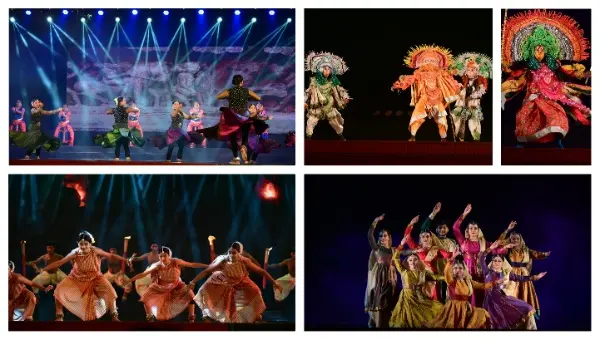
Nestled at the historic foothills of Dhauli Hill, home to the iconic Shanti Stupa built to commemorate Emperor Ashoka’s transformation after the Kalinga War, the 22nd Dhauli-Kalinga Mahotsav took place from February 6 to 8.
Organised by the Odisha Dance Academy (also known as Orissa Dance Academy) in collaboration with the Department of Culture and Tourism and Bhubaneswar Art Vision, this annual cultural extravaganza embodies the timeless message of peace, harmony, and unity through the universal language of dance and music. A hallmark event since 2003, it brings together classical, martial, and folk traditions in a serene open-air setting, where the ancient rock edicts of Ashoka overlooking the stage serve as a poignant reminder of non-violence and cultural resilience.
This edition held special significance as it coincided with the Golden Jubilee celebrations of the Odisha Dance Academy, a pioneering institution founded by the legendary Guru Gangadhar Pradhan. For over five decades, the academy has nurtured Odissi dance and promoted Odisha’s rich performing arts heritage both nationally and internationally.
Spanning three evenings (6.30 PM to 9 PM), the Mahotsav featured a vibrant line-up of performances by renowned national and international artists. Classical forms like Odissi, Bharatanatyam, and Kathak shared the stage with energetic folk dances from various regions and powerful displays of traditional martial arts such as Paika Akhada, Kallari etc. The event also included honours like the Buddha Samman and Guru Gangadhar Memorial awards for distinguished contributors to the arts, underscoring its commitment to preserving and celebrating Odisha’s cultural legacy.
Odissi’s Fluid Grace and Purulia Chhau’s Explosive Richness
The festival opened on February 6 with a choreographic Odissi presentation by Kolkata-based dancer Debamitra Sengupta. Titled Snehamayee Ganga (The Compassionate Ganga), the work paid a lyrical tribute to the sacred Ganga, portraying her as a nurturing, life-giving mother figure. With a clear linear storyline, Sengupta employed Odissi’s signature graceful movements, intricate permutations of rhythm and expression, and traditional abhinaya to evoke the river’s journey and benevolence. While the piece showcased technical proficiency and devotion to the theme, it largely adhered to predictable patterns and familiar choreographic conventions. The movements, though elegant, lacked the spark of innovation or unexpected phrasing that might have elevated the narrative beyond the conventional.
As an inaugural offering, it set a devotional and serene tone but felt somewhat safe and formulaic in its execution, missing opportunities for deeper emotional layering or contemporary interpretive flair.
It was followed by a captivating Purulia Chhau Dance performance by Susanta Mahato and his group from Kalipada Chhau Nritya Samity in Purulia. They presented Mahishasura Badha (The Slaying of Mahishasura), a powerful mythological dance-drama depicting the epic battle between Goddess Durga and the demon king Mahishasura, who embodies arrogance, tyranny, and evil. Empowered by a divine boon, the buffalo-demon Mahishasura unleashes terror across the heavens and earth, disrupting cosmic order. To restore balance and protect the universe, the fierce and radiant Goddess Durga manifests with immense divine power to confront and defeat him.
Performed in the distinctive and vigorous Purulia Chhau style rooted in martial arts, acrobatics, and folk traditions, this rendition showcased dynamic leaps, high-energy spins, athletic movements, and dramatic masked expressions. The elaborate masks, bold costumes, and pulsating rhythms brought the characters vividly to life, while the intense combat sequences emphasised raw bravery, explosive energy, precise timing, and rhythmic prec
ision.
Somehow, the use of songs and dialogue felt somewhat extraneous, since Purulia Chhau is renowned for its wordless purity, where rhythm, martial leaps, masked expressions, and instrumental music alone drive the storytelling with raw, kinetic force.
I gave the second evening a miss, so missed the Odissi performance by the students of Utkal Sangeet Mahavidyalaya, Bhubaneswar and Bharatnatyam Dance by Arupa Lahiri & group.
Aruna Mohanty’s Royal Road of Innovation: Patha Rajapatha
The concluding evening of the festival was a vibrant riot of colours, a seamless amalgamation of diverse dance forms and styles, weaving a narrative that spanned from ancient times to the modern era, rich with layered complexities.
Aruna Mohanty’s choreography walked a razor’s edge, masterfully balancing artistic expression with underlying themes, transforming what could have been mere propaganda into a transcendent, one-hour flow of seamless dance that ultimately elevated into a refined work of aesthetic beauty.
Her magnum opus, presented on the concluding evening of the Dhauli Festival, proved a captivating visual delight and yet another distinguished feather in her already crowded cap of laurels.
Titled Patha Rajapatha, this choreographic work served as a heartfelt tribute to the makers, creators, builders, and architects of Indian civilization. While cantered on the theme of the “road” or pathway, the storyline traversed thousands of years, encompassing multiple facets of nation-building, all connected through the metaphor of a grand highway. This intricate narrative was masterfully woven through classical dance forms such as Odissi, Kathak, and Bharatanatyam, blended harmoniously with the folk and tribal dances of Odisha.
The performance took the audience on an evocative journey—from the ancient era to the age of artificial intelligence—through superbly crafted sequences that brought dreams to life.
A testament to veteran choreographer Aruna Mohanty’s brilliance and the dedication of her pupils at the Orissa Dance Academy, Patha Rajapatha stood out as a fusion of classical, folk, and contemporary styles, delivering a profound and visually stunning celebration of India’s enduring cultural legacy.
Sita, the warrior of Mithila
The second programme of the evening featured a refined Kathak recital by Souvik Chakraborty and his group, Nrityadisha from Kolkata. They presented a captivating Darbari composition set to Teen Taal in Raag Darbari, followed by a poignant Ghazal that beautifully evoked the intimate, seated expressiveness of baithaki bhava. The entire choreography was crafted by Souvik Chakraborty himself, showcasing his signature finesse in blending tradition with emotive depth.
The concluding performance of the evening was Sita, a dynamic Kalaripayattu-based production by Belraj Soni and his group from Navaneetham Cultural Trust, Kerala. This reimagined epic brought the timeless story of Sita. In this powerful reimagining—inspired by Amish Tripathi’s Sita: Warrior of Mithila—she emerges as a skilled fighter, a princess with elegance, choice, and unyielding strength, embodying resilience and defiance through the dynamic language of Kalaripayattu and integrated classical forms. This portrayal reframes her not merely as a symbol of endurance, but as an empowered protagonist who claims her own narrative with fire and precision.
Conceived and directed by Belraj Soni, it offered a bold, contemporary interpretation—portraying Sita not merely as a figure of endurance, but as a warrior in her own right—delivering a visually striking and physically intense finale to the festival.
Message of Peace
In a world often divided, the Dhauli-Kalinga Mahotsav stands as a living tribute to peace—where dance becomes both prayer and protest against conflict, echoing Ashoka’s edicts carved into the very hill that cradles the stage. This year’s Golden Jubilee edition reinforced the Odisha Dance Academy’s enduring vision: to let art foster harmony, one graceful step at a time.
(The opinion expressed in the article are solely the author’s and don’t reflect the opinions or beliefs of the website and its affiliates)