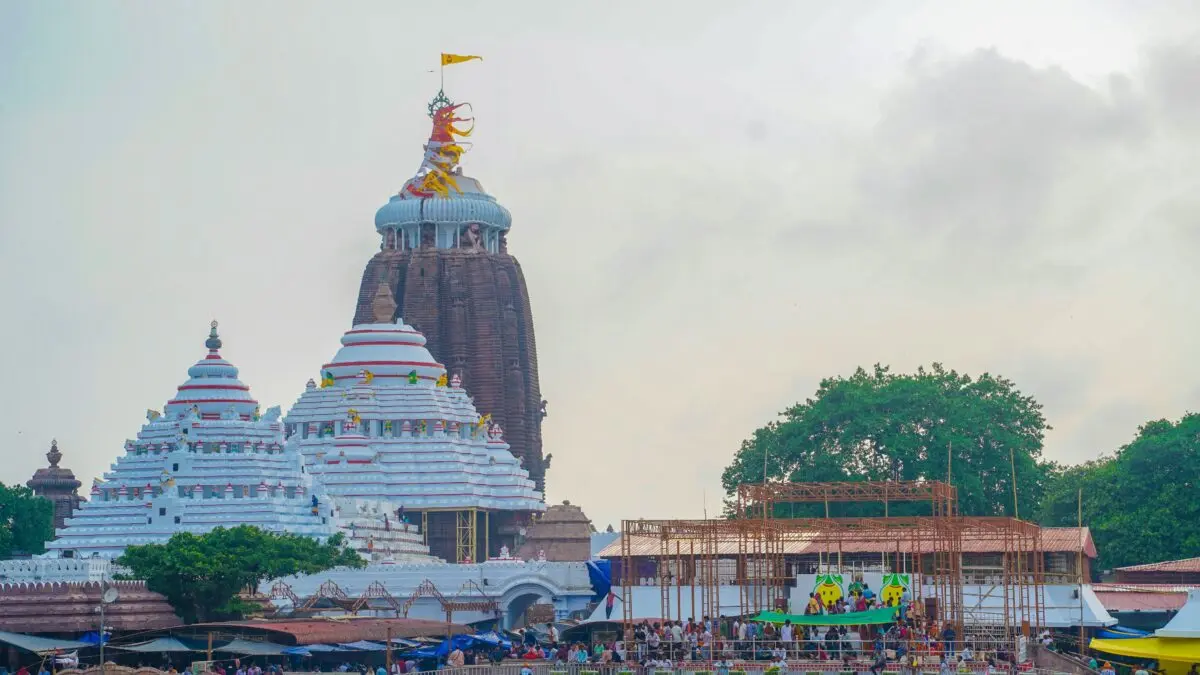
Puri: Debasnana Purnima rituals, which is a prelude to the annual Rath Yatra of the sibling deities, are underway at Shree Jagannath Temple in Odisha’s Puri.
To manage the massive influx, the police administration has made extensive arrangements. The town has been divided into special security zones with heavy police deployment. For crowd and traffic control, 79 platoons of police force have been deployed under the supervision of four SP-rank officers. Adequate police personnel have been stationed both inside and outside the 12th-century shrine to ensure a hassle-free darshan for pilgrims. Over 400 CCTV cameras (152 inside the temple, 252 along the Parikrama, and 30 on barricades) will track crowd movement. Traffic diversions, designated parking zones and regulated entry and exit routes have also been planned to minimise congestion.
Devotees will enter the shrine exclusively through the Singhadwara (Lion’s Gate) and exit via the other three gates to ensure one-way flow. Those holding Pahandi tickets can enter via the southern gate (Dakshina Dwara) in the morning. A strict one-way queue system will start from Market Chhak toward the Lion’s Gate.
The Snana Mandap (Bathing Pavilion) have been decorated with painting and colourful adornment work.
Snana Jatra
Snana Jatra, also known as Debasnana Purnima, is a ceremonial bath ceremony of the sibling deities held on Purnima (full moon day) of Jyestha month.
As per the tradition, Lord Jagannath, Balabhadra and Devi Subhadra are escorted from the sanctum sanctorum to the Snana Mandap (bathing altar) in a ‘Pahandi’ (procession) after ‘Mangal Arati’. The mandap is an elevated platform on the temple premises facing east overlooki
ng the Bada Danda. To be able to bear the stress during the procession, the deities are made to wear ‘Senapatta’, a body armour made of ‘Baula’ wood, by the Daitapatis who take charge of the deities from regular priests the previous night.
It is here on the mandap that they are given a ritualistic bath after the sevayats perform a complex set of rituals. ‘Chhera Pahanra’, the ceremonial sweeping, is then performed by Puri King Gajapati Maharaja Dibyasingha Deb, following which ‘Sahan Mela’ or public darshan is allowed.
Rituals
The procession, in which the divine deities are brought to Snana Mandap, is called ‘Pahandi’.
The water used for bathing the deities is taken from the Suna Kua (well) on the temple premises. After performing the rituals, 108 pitchers of herbal and aromatic water are used for bathing the three sibling deities.
All the pots, preserved in the ‘Bhoga Mandap’, are first purified using turmeric, sandalwood and flowers. A set of special priests, ‘Suaras’, take these pots from the golden well to the bathing altar.
This ritual is called ‘Jalabhisheka’.
Notably, the holy water is drawn from the well once a year.
Hati Besha
After completion of the bathing ceremony, the deities are decked up in ‘Sada Besha’. Later in the day, Lord Jagannath, Devi Subhadra and Lord Balabhadra are adorned in Hati Besha (a form of Lord Ganesha).
While Lord Jagannath and Lord Balabhadra are dressed like elephants, Goddess Subhadra dons lotus flower Besha.
A special ‘Bhog’ is also prepared as an offering.
Anasara Period
At night, the deities are taken to the ‘Anasara Ghar’ (an asylum for the sick) on the temple premises having supposedly fallen ill after the elaborate bath and allowed to recuperate for 14 days when there is no public darshan. During this period, they are offered only fruits and water, mixed with cheese and ‘Dasamula’ medicines by the temple physician.
With 108 pitchers of water having been poured on the deities, the colours too fade out, following which, the ‘Daitas’ repaint the idols.
Importance Of Snana Purnima
The devotees believe that a glimpse of the deities on this auspicious day will rid them of all sins. Thousands of devotees visit the Shri Jagannath Temple on this occasion.