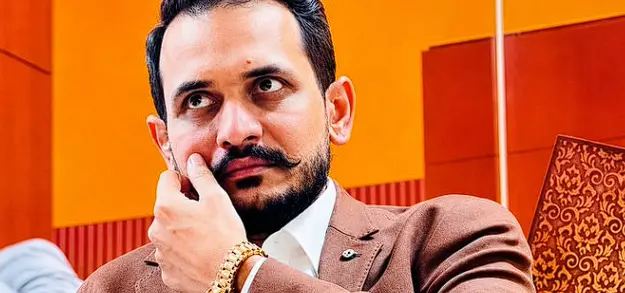
New Delhi: Shahzad Bhatti, a Pakistani social-media figure who styled himself as a businessman and defender of religion under the “333” banner, is now the subject of multiple Indian security probes that allege he played a central role in a growing cross-border crime and terror network.
Bhatti, thought to be about 45, amassed a following by posting videos on religion, influencer disputes and India-Pakistan tensions. Indian investigators say his online persona masks deeper criminal and extremist ties and that he has been instrumental in recruiting and directing followers for violent acts inside India, as reported by the Indian Express.
On Saturday, the Delhi Police’s Special Cell arrested nine people from Uttar Pradesh, Madhya Pradesh, Jammu and Kashmir, Punjab and Gujarat. Investigators allege the suspects were planning strikes on a historic temple in Delhi, a popular eatery on the Delhi–Sonipat highway and a military facility in Haryana. The arrests renewed attention on Bhatti, who “insists he is neither a gangster nor a mafia boss,” according to officials.
Bhatti first attracted police scrutiny in Pakistan’s Punjab province in 2013, when authorities registered theft and robbery cases against him. Over the years more complaints — including rape allegations, which he denies — accumulated, and local reports have linked him to Lahore’s criminal underworld, where figures such as Farrukh Khokhar operate. Bhatti has publicly downplayed such ties, calling them “friendships rather than organisational ties”.
Believed to have moved to the UAE around 2015, Bhatti claims to run a scrap trading business and agricultural and dairy ventures. His
current whereabouts are uncertain; investigators say he appears to shuttle between Pakistan and Gulf countries.
Bhatti rode TikTok’s surge in Pakistan after 2018, growing an audience with content on religion, nationalism and online controversies. He marks posts with the ‘333’ emblem, which he describes not as an organised group but as a “personal identifier”. He positioned himself as a defender of religious causes, frequently commenting on blasphemy disputes involving Pakistani influencers, including the April 2025 shooting outside influencer Rajab Butt’s residence.
A notable feature of Bhatti’s public narrative is his claimed link with jailed Indian gangster Lawrence Bishnoi. Bhatti says the relationship began after he sought help over alleged anti-Islam social media content. Investigators later tied Bhatti to Zeeshan Akhtar, an alleged Bishnoi aide accused in the October 2024 killing of former Maharashtra minister Baba Siddique. The rapport reportedly cooled after Bishnoi made anti-Pakistan remarks following last year’s Pahalgam terror attack.
Indian agencies began probing Bhatti more closely after a grenade attack in Jalandhar, Punjab, in March 2024, near influencer Rozer Sandhu’s home; investigators alleged Bhatti had orchestrated the incident. In recent months they have also alleged Bhatti’s links to Pakistan’s Inter-Services Intelligence and accused him of radicalising unemployed youth to expand his reach in India.
More than a dozen FIRs have been filed against Bhatti across Delhi, Uttar Pradesh, Punjab, Haryana, Rajasthan and Uttarakhand, and the NIA has registered some cases, including charges invoking acts that endanger India’s sovereignty, unity and integrity.
The Maharashtra Anti-Terrorism Squad, which on May 13 raided nearly 40 locations and questioned 53 people who had interacted with Bhatti-linked accounts, said the exercise offered “insight into what they described as the network’s online radicalisation model.”
An ATS source said, “They are promised solutions to their problems and given inducements,” and described a recruitment process that begins with small tasks and escalates “once they realise the person is motivated.” The ATS framed the operation as preventive monitoring to stop online outreach from developing into a larger threat.