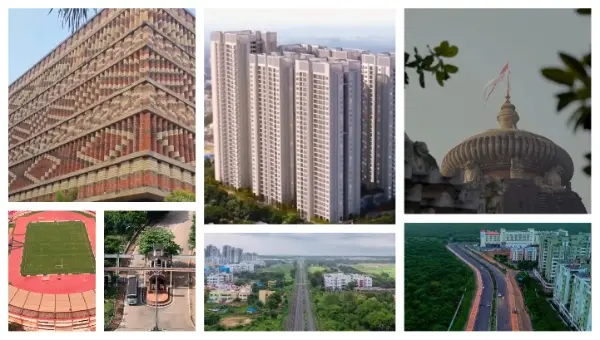
Bhubaneswar: Odisha capital Bhubaneswar is gleaming with festive splendour, adorned like a radiant bride for its 78th Foundation Day. The city’s grand squares and the boulevard stretching from Lok Seva Bhawan till Legislative Assembly is shimmering and sparkling under a canopy of vibrant, multicoloured lights, captivating the hearts of both proud residents and enchanted visitors alike.
Though the city and its temples are much older, on this day in 1948 the foundation for the modern capital was laid.
In honour of this cherished milestone, a symphony of official and cultural events have been planned across the capital. A ‘Rajdhani Mahotsav’ has been woven into the very soul of the city, celebrating its vibrant spirit. At the heart of it all, the grandest celebration unfolds at Odisha Legislative Assembly, where distinguished dignitaries and devoted citizens gather in harmonious unity to pay tribute and commemorate this auspicious occasion.
“On the 78th Capital Foundation Day, we celebrate Bhubaneswar — the heart of Odisha’s identity and progress. From its historic roots to its modern aspirations, this city embodies resilience, culture, and innovation. I take pride in honouring the visionaries who shaped our capital and the people whose spirit continues to dri
ve its growth. May Bhubaneswar keep shining as a beacon of heritage and development for generations to come,” Odisha Deputy Chief Minister K V Singh Deo posted on social media
Here are some historical facts about the Odisha capital and its grand journey of development from the temple city to a modern metropolis:
* India’s first Prime Minister Jawaharlal Nehru laid the foundation stone of Bhubaneswar on April 13, 1948.
* The masterplan of Bhubaneswar was designed by German architect Otto Königsberger in 1948 for a population of 40,000. It is among the first four planned cities of India. Today, it is home to more than 14 lakh people.
* Bhubaneswar has a 3,000-year-old history, beginning from Mahamegha-Bahana Chedi dynasty with Sisupalgarh as its capital.
* The name Bhubaneswar was derived from Tribhubaneswar, which means the Lord (Eswar) of the Three Worlds (Tribhuvan), referring to Shiva.
* Bhubaneswar is also known as Toshali, Kalinga Nagari, Ekamra Kanan, Ekamra Kshetra and Mandira Malini Nagari, reflecting its cultural and historical significance.
* Bhubaneswar was once home to nearly 700 temples. Even today, hundreds of these ancient temples are still standing.
* The Kalinga War, one of the deadliest in Indian history, took place on the Dhauli hills along the banks of the Daya River. According to his 13th Major Rock Edict, he felt deep sorrow and regret for the slaughter, death, and captivity that occurred during the conquest of Kalinga. He then built Dhauli Stupa to signify his intention to surrender to Buddhism and crave for peace.
* In 1948, just a year after India gained independence, Bhubaneswar replaced Cuttack as the capital of Odisha.